Saturday, April 16, 2005
The population of our county until very recently has been made up of blue collar tradesman, laborers and farmers. Now, those of us who farm even part time are an ever-decreasing minority as suburban sprawl invades our hillsides. We are still mostly blue-collar, but with the influx of commuters seeking cheaper housing, our working folk are beginning to be priced out of the houses they help build. Beside commuters we have would-be country gentry who come out to buy a big house with some acreage for their horse. Oddly enough, we do have a horsey set out here already. Some are part of the Gold Cup Race/fox hunting set more properly found in the counties east of us. Others are part of a group that is hard to find outside places like Warren County, the blue-collar horseman (or woman). Yes, we have folks who are rednecks with saddles and proud of it. I was behind a pick-up belonging to one member of that group yesterday; truck bed full of sweet feed from Southern States and a bumper sticker that said: "My horse bucked off your honor student."


Friday, April 15, 2005
The priest at my home parish, Fr. Alexander Webster, notes the passing of Archbishop Iakovos, the retired chief hierarch of the Greek Archdiocese, in today's Wall Street Journal.
Thursday, April 14, 2005
Today's link is Moonmeadow Farm, a blog from the mountains of North Carolina. (North Carolina is the quiet cousin stuck between South Carolina and Virginia; a "gentle valley between two towering mountains of conceit" as I heard one wag put it.) She raises goats on 85 rented acres and the family is searching for a more permanent place in the world. Our author also has a great quote on her site which is worth sharing here: "It is a rule of nature that taking a day off on a farm sets a person back at least a week. --Jane Hamilton in A Map of the World."
Wednesday, April 13, 2005
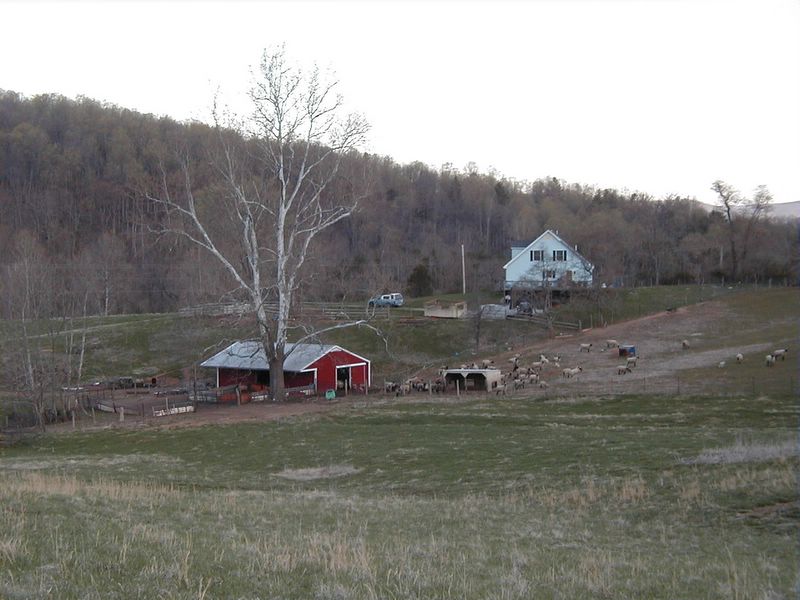
A pack of dogs came into the field yesterday morning, two adults and four half grown pups. The sheep and llamas were disturbed to say the least. I took the truck up the hill and encouraged them to move on. I am still on good terms with our animal wardens from my days as a prosecutor, so I passed the word on when I saw them in Court later that day. Roving dogs are one of the great challenges to the sheep farmer here in the east, even worse probably than the coyotes who have made themselves at home in our mountains. While heading back down to the barn I took this picture. As you can see, the pasture is getting green again, but it is still too early for the trees to leaf. Maybe another week or so.
Tuesday, April 12, 2005
Monday, April 11, 2005
Today's blog link is Mountainfarmstead. At the head of her site is a quotation I might be tempted to steal for myself:
“A journal always conceals vastly more than it reveals.
It’s a poor substitute for memory, and memory is what I would like to nourish.
But if I do give in, this is what I have in mind. I want to count the crows in the field every afternoon.
I want to record the temperatures, high and low, every day and measure the rain and snow…”
Verlyn Klinkenborg ( THE RURAL LIFE )
If I counted correctly, today's blogger is still shy thirty names for this year's crop of kids. (Those are baby goats for you suburbanites.) If you have suggestions that begin with the letter "T" she wants your input. So far there are a Tallulah, a Tully, a Tyler, a Tia, a Tya, a Tuppence and a Tommy. If the rest are anything like other goats I have known, they are probably being called things that begin with many other letters than T, so stop on by and save them from the ignomy. Stop by in any case for the goat pictures and a little taste of farm life.
“A journal always conceals vastly more than it reveals.
It’s a poor substitute for memory, and memory is what I would like to nourish.
But if I do give in, this is what I have in mind. I want to count the crows in the field every afternoon.
I want to record the temperatures, high and low, every day and measure the rain and snow…”
Verlyn Klinkenborg ( THE RURAL LIFE )
If I counted correctly, today's blogger is still shy thirty names for this year's crop of kids. (Those are baby goats for you suburbanites.) If you have suggestions that begin with the letter "T" she wants your input. So far there are a Tallulah, a Tully, a Tyler, a Tia, a Tya, a Tuppence and a Tommy. If the rest are anything like other goats I have known, they are probably being called things that begin with many other letters than T, so stop on by and save them from the ignomy. Stop by in any case for the goat pictures and a little taste of farm life.
Sunday, April 10, 2005
After a long Saturday down at the sheepbarn, I was moving a little slow Sunday morning and the time for leaving to liturgy came and went while I was still doing the morning chores. Our rams were a little slow off the mark last summer so we are still having lambs, which means the seasonal work has spread from winter into spring. I feel bad about missing Church, but take some comfort, that if I were Catholic, my absence would be deemed respectable. From Father Jim Tucker at Dappled things: A question that frequently comes up in the summertime is what constitutes an excuse from the Sunday Mass obligation. Because modern-day Catholics have become very lax in their Mass attendance, one sometimes encounters a rigorist approach to the precept, which errs on the opposite extreme. So, I thought I would post these excerpts from Moral and Pastoral Theology, vol. 2, by Fr Henry Davis, SJ, published in London in 1936. Since everyone asks about excuses, these are the parts I've chosen. (and here is the part I have selected out of his selection) "It is held that those are excused who would have to forgo -- occasionally, but not as a general rule -- a good stroke of business or considerable gain, such as would be the case with merchants, and during the lambing season with farmers...."
Saturday, April 09, 2005
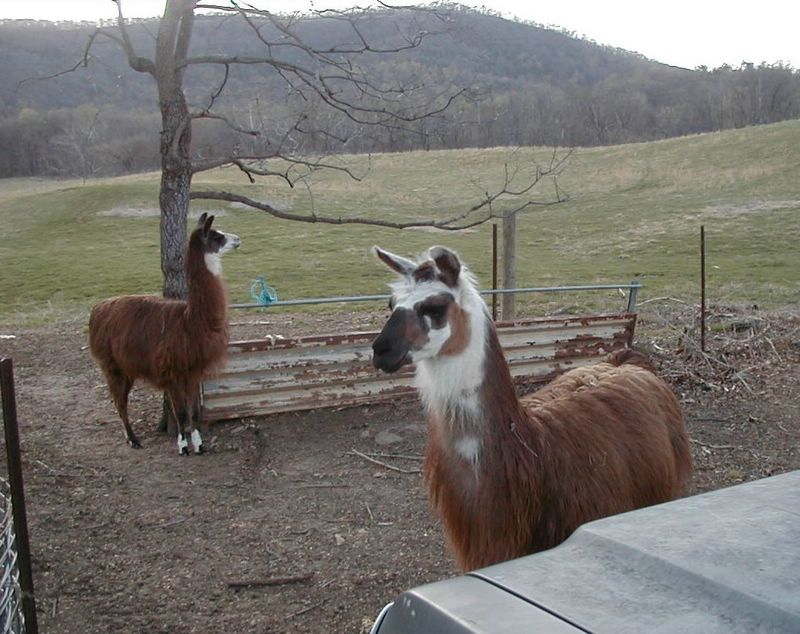
Been there, done that, though never in Grand Rapids. For our own tale of llamas on the loose, go here in the archives.
Friday, April 08, 2005
There are a number of fine blogs out there that have linked this one. Until I actually get around to reworking my links on the right hand side, I will be featuring one or more of them each couple of days, both out of thanks for the link, and because they are well worth a visit in their own right. Todays link is The Ink Spinnery, raiser of homing pigeons, eraser carver and future homesteader.
Thursday, April 07, 2005
Gideon Strauss has linked to my answers to his first three questions. This is both gratifying and embarrassing. Gratifying, because he has kind things to say about my responses. Embarrassing, because I still have yet to answer two of his questions. While both of the remaining questions are good, the last is particularly thought provoking: "What are the deepest connections between your Orthodoxy, farming, and lawyerly practice?" There is a refreshingly non post-modern assumption there, that a life is not a bricolage of unrelated fragments. To put it in literary terms, we are all writing novels, not short story collections. To put it musically, is your life like a Bach cantata where a coherent whole is created by interweaving and mutually enriching parts, or more like a group of unrelated concert pieces that happen to be performed by a single musician? Teasing out the underlying themes from the everyday racket of life requires more thought than I have had time to give it yet. Perhaps this weekend!
Wednesday, April 06, 2005




Tuesday, April 05, 2005
Post-modern literary adventurer Mark Woods offered a belated birthday greeting yesterday to one of my favorite poets, Irina Ratushinskaya. I wrote about her two years ago and suggested her as a suitable companion during Lent. In one of her poems written in a Soviet forced labor camp she labels the era we live in "Cainozoic", that is, the age in which we slay our brother. Her work can ring with anger and she is well acquainted with loss. Nonetheless, through it all there is hope, and even joy in her writing. Cornerstone Press has a recent collection of her poems for those who are interested in reading more.
Monday, April 04, 2005
One of my favorite stops of late has been Minor Clergy, the blog of a part time Orthodox seminarian and full time practicing attorney. Last week he posted a couple of entries on the tensions that arise when the journey to holiness meets the practice of law. The first one is here, with the follow up here.
Sunday, April 03, 2005
Early Spring weather is always changeable, but this weekend we ran the gammut. Torrential downpours, bright sun, high wind gusts and, this morning, the bright white of snow on Hogback. If we get tomorrow's promised sun, we can watch this weekend's rain turn into the light green of Spring pasture.
Today is the third Sunday in Lent in the Orthodox Calendar, the Sunday of the Life-Giving Cross:
Now the flaming sword no longer guards the gates of Eden;
it has mysteriously been quenched by the wood of the Cross!
The sting of death and the victory of hell have been vanquished;
for You, O my Savior, have come and cried to those in hell:
"Enter again into paradise."
Today is the third Sunday in Lent in the Orthodox Calendar, the Sunday of the Life-Giving Cross:
Now the flaming sword no longer guards the gates of Eden;
it has mysteriously been quenched by the wood of the Cross!
The sting of death and the victory of hell have been vanquished;
for You, O my Savior, have come and cried to those in hell:
"Enter again into paradise."
Saturday, April 02, 2005
I heard the announcement of the death of John Paul II this afternoon while heading over Chester Gap on the way to pick up sheep feed at the Rhappahanock Co-op. Driving home in the rain with the smell of molasses and rolled corn rising from a dozen feed sacks, I listened to outpourings of grief and heart-felt tributes from across the world. I will not attempt to summarize the legacy of this great man, but will instead simply quote some lines from his book Crossing the Threshold of Hope:
At the end of the second millennium, we need, perhaps more than ever, the words of the Risen Christ: "Be not afraid!" Man who, even after the fall of Communism, has not stopped being afraid and who truly has many reasons for feeling this way, needs to hear these words. Nations need to hear them, especially those nations that have been reborn after the fall of the Communist empire, as well as those that witnessed this event from the outside. Peoples and nations of the entire world need to hear these words. Their conscience needs to grow in the certainty that Someone exists who holds in His hands the destiny of this passing world; Someone who holds the keys to death and the netherworld (cf. Rev 1:18); Someone who is the Alpha and the Omega of human history (cf. Rev 22:13)-- be it the individual or collective history. And this Someone is Love (cf. 1 Jn 4:8, 16)-- Love that became man, Love crucified and risen, Love unceasingly present among men. It is Eucharistic Love. It is the infinite source of communion. He alone can give the ultimate assurance when He says "Be not afraid!"
At the end of the second millennium, we need, perhaps more than ever, the words of the Risen Christ: "Be not afraid!" Man who, even after the fall of Communism, has not stopped being afraid and who truly has many reasons for feeling this way, needs to hear these words. Nations need to hear them, especially those nations that have been reborn after the fall of the Communist empire, as well as those that witnessed this event from the outside. Peoples and nations of the entire world need to hear these words. Their conscience needs to grow in the certainty that Someone exists who holds in His hands the destiny of this passing world; Someone who holds the keys to death and the netherworld (cf. Rev 1:18); Someone who is the Alpha and the Omega of human history (cf. Rev 22:13)-- be it the individual or collective history. And this Someone is Love (cf. 1 Jn 4:8, 16)-- Love that became man, Love crucified and risen, Love unceasingly present among men. It is Eucharistic Love. It is the infinite source of communion. He alone can give the ultimate assurance when He says "Be not afraid!"

Friday, April 01, 2005
My favorite contemporary Orthodox theologian is at it again. David Bentley Hart gives his perspective on the Terry Schiavo controversy in today's Wall Street Journal. In reading responses to one of Hart's pieces it is always interesting to see how many of the respondants miss his point entirely by not paying attention to what he is actually saying. Hart's prose style can be demanding, even when he is writing in a more "popular" vein. He assumes the reader is actually familiar with the meaning, or meanings, of words. Just one example; he states of those in Schiavo's condition: "Even among such ravages--for those with the eyes to see it--a terrible dignity still shines out." One reader responded: As for the theologian's suggestion that even in the ravages of a damaged brain, a "terrible dignity still shines out," I suggest he also missed the mark. Recently, I spent the last week of my brother Bill's life with him in a VA hospice as he died from both lung and brain cancer. He was paralyzed on his right side, unable to speak. Already frail, he stopped eating and drinking days before he died. He spent much of his last three days transitioning into the afterlife. But until Bill's last breath, his eyes and hand squeezes communicated the magnificent dignity and beauty--and life--of one of God's children. As I read Hart, he is using "terrible" in the sense of inciting dread or awe, surely an appropriate response to the human mystery in an extreme and painful situation. "Terrible" in the sense that we should know that we stand on holy ground, and should approach with reverence. A thought that Hart's correspondant actually affirms in his own moving story.
Hart's follow up to the controversy raised by his previous Wall Street Journal essay on theodicy and the South Asian Tsunami is now online at First Things. Here is an excerpt:
I do not believe we Christians are obliged—or even allowed—to look upon the devastation visited upon the coasts of the Indian Ocean and to console ourselves with vacuous cant about the mysterious course taken by God’s goodness in this world, or to assure others that some ultimate meaning or purpose resides in so much misery. Ours is, after all, a religion of salvation; our faith is in a God who has come to rescue His creation from the absurdity of sin and the emptiness of death, and so we are permitted to hate these things with a perfect hatred. For while Christ takes the suffering of his creatures up into his own, it is not because he or they had need of suffering, but because he would not abandon his creatures to the grave. And while we know that the victory over evil and death has been won, we know also that it is a victory yet to come, and that creation therefore, as Paul says, groans in expectation of the glory that will one day be revealed. Until then, the world remains a place of struggle between light and darkness, truth and falsehood, life and death; and, in such a world, our portion is charity.
Hart's follow up to the controversy raised by his previous Wall Street Journal essay on theodicy and the South Asian Tsunami is now online at First Things. Here is an excerpt:
I do not believe we Christians are obliged—or even allowed—to look upon the devastation visited upon the coasts of the Indian Ocean and to console ourselves with vacuous cant about the mysterious course taken by God’s goodness in this world, or to assure others that some ultimate meaning or purpose resides in so much misery. Ours is, after all, a religion of salvation; our faith is in a God who has come to rescue His creation from the absurdity of sin and the emptiness of death, and so we are permitted to hate these things with a perfect hatred. For while Christ takes the suffering of his creatures up into his own, it is not because he or they had need of suffering, but because he would not abandon his creatures to the grave. And while we know that the victory over evil and death has been won, we know also that it is a victory yet to come, and that creation therefore, as Paul says, groans in expectation of the glory that will one day be revealed. Until then, the world remains a place of struggle between light and darkness, truth and falsehood, life and death; and, in such a world, our portion is charity.
Subscribe to:
Posts (Atom)