Tuesday, May 17, 2005
Orthodoxy has a rich tradition of choral music. Our services are chanted and sung rather than spoken, with the human voice as the only instrument. Each national church has its own musical traditions, but underlying all of them are the eight modes or "tones" of Byzantine Chant. The traditional tones can be quite a shock to someone who has only encountered Orthodox music in its lush, more westernized Russian incarnation. It is emphatically not western sounding, with a modal scale that strikes the uninitiated as sounding positively middle-eastern. Nonetheless, once you get your ears adjusted, there is a delicate and somber beauty that is hard to reproduce in Western notation. I have made a few attempts at the traditional tones over the years. The result was disheartening, rather like listening to the Lawrence Welk Orchestra working its way through the B. B. King songbook. Nonetheless, I still have hopes. The Greek Archdiocese has a resource for the do-it-yourself student at its On-Line Chapel; a whole page of links to introduce the novice to Byzantine Chant.


Monday, May 16, 2005
Today Huw links to a site on apocalyptic ideas in Old English literature. It brought back fond memories of staring bleary-eyed at my copy of Beowulf back in 1977 trying to turn the oddly familiar yet foreign phrases of Anglo-Saxon into something I could understand. Besides the links to the apocalyptic material (no, it did not start with the "Left Behind" books) there is a wonderful set of links to materials on Old English life and literature, including language lessons. The site contains my own favorite Old English poem, The Dream of the Rood, a uniquely Anglo-Saxon poetic meditation on the Cross.
Sunday, May 15, 2005
It has been a while since I have put up a post linking back to one of the bloggers who show up regularly in my referrer logs. Todays link is Ever So Humble, a blog from the New Hampshire Seacoast. She has become a favorite stop for information on everything from seasonal changes to high school lacrosse to the Weekly World News.
Saturday, May 14, 2005

We had planned on shearing the first of the flock this afternoon. A thunderstorm had plans of its own, so we spent the afternoon inside watching rain blowing down sideways instead. With each lightning flash, the portable phone in the kitchen would ring once before the thunderclap. Mother Nature calling!




For those who check regularly, my apologies for the lack of posts. I took some time off and went down to Florida to visit family. The picture above is the view from Caspersen Beach last Saturday, looking out over the Gulf of Mexico. I have been back since Tuesday night, but caught up in the press of work since then. After a short burst of vacation pictures, regular farm blogging will resume.
Monday, May 02, 2005
This week after Pascha is "Bright Week" in the Orthodox Church. The customary Wednesday/Friday fasts are lifted and we greet one another with "Christ is Risen!", to which one responds, "Indeed, he is risen!" The website of the Orthodox Church in America has a special page with the Paschal Greeting in languages ranging from Aleut to Coptic to Latvian to Romanian to Zulu. My current favorite is Hawaiian:
Ua ala hou 'o Kristo!
Ua ala 'I 'o no 'oia!
Ua ala hou 'o Kristo!
Ua ala 'I 'o no 'oia!
Update: Father Steven Bigham has a new site where you can read (and hear!) the Paschal Greeting in 250 different languages. (Link via Orthodoxy Today)
Sunday, May 01, 2005
The BBC has a wonderful audio portrait of Orthodox Easter here, narrated by Canon Michael Bourdeaux, an Anglican priest who was a great friend of the suffering Church in Russia under the Communists. He also interviews Irina Ratushinskaya, whom I have written about before.
Saturday, April 30, 2005
Friday, April 29, 2005

The wounded surgeon plies the steel
That questions the distempered part;
Beneath the bleeding hands we feel
The sharp compassion of the healer's art
Resolving the enigma of the fever chart.
Our only health is the disease
If we obey the dying nurse
Whose constant care is not to please
But to remind of our, and Adam's curse,
And that, to be restored, our sickness must grow worse.
The whole earth is our hospital
Endowed by the ruined millionaire,
Wherein, if we do well, we shall
Die of the absolute paternal care
That will not leave us, but prevents us everywhere.
The chill ascends from feet to knees,
The fever sings in mental wires.
If to be warmed, then I must freeze
And quake in frigid purgatorial fires
Of which the flame is roses, and the smoke is briars.
The dripping blood our only drink,
The bloody flesh our only food:
In spite of which we like to think
That we are sound, substantial flesh and blood—
Again, in spite of that, we call this Friday good.
From "East Coker"; The Four Quartets
That questions the distempered part;
Beneath the bleeding hands we feel
The sharp compassion of the healer's art
Resolving the enigma of the fever chart.
Our only health is the disease
If we obey the dying nurse
Whose constant care is not to please
But to remind of our, and Adam's curse,
And that, to be restored, our sickness must grow worse.
The whole earth is our hospital
Endowed by the ruined millionaire,
Wherein, if we do well, we shall
Die of the absolute paternal care
That will not leave us, but prevents us everywhere.
The chill ascends from feet to knees,
The fever sings in mental wires.
If to be warmed, then I must freeze
And quake in frigid purgatorial fires
Of which the flame is roses, and the smoke is briars.
The dripping blood our only drink,
The bloody flesh our only food:
In spite of which we like to think
That we are sound, substantial flesh and blood—
Again, in spite of that, we call this Friday good.
From "East Coker"; The Four Quartets
Thursday, April 28, 2005
Holy Thursday commemorates the Last Supper, the washing of the disciples feet, and the betrayal by Judas.
Of your mystical Supper, Son of God, receive me today as a communicant; for I will not tell of the Mystery to your enemies; I will not give you a kiss, like Judas; but like the Thief I confess you: Remember me, Lord, in your Kingdom.
Of your mystical Supper, Son of God, receive me today as a communicant; for I will not tell of the Mystery to your enemies; I will not give you a kiss, like Judas; but like the Thief I confess you: Remember me, Lord, in your Kingdom.
Wednesday, April 27, 2005
Father Joseph at Orthodixie has posted a useful tour of Orthodox Holy Week for those who are curious.
Tuesday, April 26, 2005
We are now well into Holy Week, only days left before Good Friday and Pascha. As always, words fail. I commend to you the services for the week, which can be found at Archimandrite Ephraim's indispensable site. For myself, I turn again to Eliot:
So here I am, in the middle way, having had twenty years--
Twenty years largely wasted, the years of l'entre deux guerres
Trying to use words, and every attempt
Is a wholly new start, and a different kind of failure
Because one has only learnt to get the better of words
For the thing one no longer has to say, or the way in which
One is no longer disposed to say it. And so each venture
Is a new beginning, a raid on the inarticulate
With shabby equipment always deteriorating
In the general mess of imprecision of feeling,
Undisciplined squads of emotion. And what there is to conquer
By strength and submission, has already been discovered
Once or twice, or several times, by men whom one cannot hope
To emulate--but there is no competition--
There is only the fight to recover what has been lost
And found and lost again and again: and now, under conditions
That seem unpropitious. But perhaps neither gain nor loss.
For us, there is only the trying. The rest is not our business.
From "East Coker"; The Four Quartets
So here I am, in the middle way, having had twenty years--
Twenty years largely wasted, the years of l'entre deux guerres
Trying to use words, and every attempt
Is a wholly new start, and a different kind of failure
Because one has only learnt to get the better of words
For the thing one no longer has to say, or the way in which
One is no longer disposed to say it. And so each venture
Is a new beginning, a raid on the inarticulate
With shabby equipment always deteriorating
In the general mess of imprecision of feeling,
Undisciplined squads of emotion. And what there is to conquer
By strength and submission, has already been discovered
Once or twice, or several times, by men whom one cannot hope
To emulate--but there is no competition--
There is only the fight to recover what has been lost
And found and lost again and again: and now, under conditions
That seem unpropitious. But perhaps neither gain nor loss.
For us, there is only the trying. The rest is not our business.
From "East Coker"; The Four Quartets
Monday, April 25, 2005
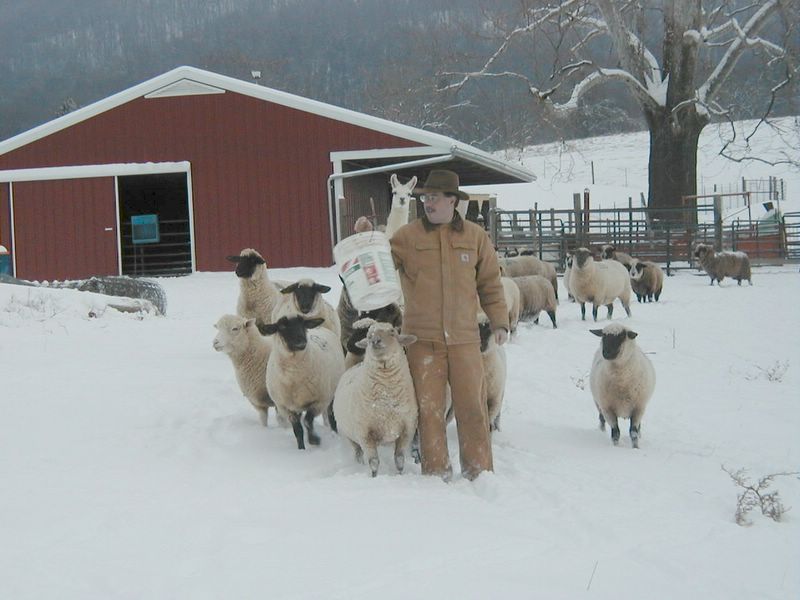
No, we did not have a sudden spring snow here. If you look over to the right, you will recognize this as the picture from my profile, seen full size for a change. My laptop is off for service, so I resurrected the old computer in my library and spent the evening browsing through and indexing images on the hard drive. I may put up a few other archive images over the next couple of weeks. If you have a favorite scene or subject, let me know and I will try and find the appropriate picture.
Sunday, April 24, 2005
With Palm Sunday we move from Lent into Holy Week. As usual, as I look back on Lent I find that my customary sins and failings have made it past the last few weeks of fasting and introspection and now go with me to Pascha. What then is the value of Lent? Perhaps for those of us struggling far from sainthood it is that we do not grow too comfortable with our faults. It is far too easy to cease from trying and settle down with our favorite sins, thinking that, after all, we are only human and our failings are not so bad now, are they? Why bother with all the drama of repentance when life is short and comfort precious? This is perhaps the kind of "wisdom" T. S. Eliot had in mind when he wrote:
. . . . Do not let me hear
Of the wisdom of old men, but rather of their folly,
Their fear of fear and frenzy, their fear of possession,
Of belonging to another, or to others, or to God.
The only wisdom we can hope to acquire
Is the wisdom of humility: humility is endless.
From "East Coker"; The Four Quartets
. . . . Do not let me hear
Of the wisdom of old men, but rather of their folly,
Their fear of fear and frenzy, their fear of possession,
Of belonging to another, or to others, or to God.
The only wisdom we can hope to acquire
Is the wisdom of humility: humility is endless.
From "East Coker"; The Four Quartets


Subscribe to:
Posts (Atom)