Thursday, January 13, 2005


The view from home 1-13-05

Wednesday, January 12, 2005

Sometime last week I ran across a post on Hugh Hewitt's blog about a PR company offering passes to screenings of a new movie, In Good Company to bloggers in exchange for discussing the movie on their sites. O.K., I say to myself, someone is willing to cover the movie half of dinner-and-a-movie with the wife because I write the odd paragraph about scenery and sheep and would be willing to throw a movie review into the mix? That hit high enough on the whimsy scale to be worth an e-mail or two. I got a prompt response from Emily at Grace Hill Media with notice of the time and date for a showing in Bethesda, Maryland Tuesday night. Susan had early Wednesday morning appointments with schools in Maryland so was planning to spend the night in the city anyhow. So, on Tuesday I left work early, finished up the farm chores, checked that older and younger son were settled in with the in-laws and headed the blue pick-up into the city to meet up with Susan.

It was a great evening out on the town with my beloved, and as a bonus, the movie wasn't bad either. Now we are not talking Citizen Kane here, but it was a cut above what passes for a comedy these days. Most remarkably, it is a film for grown-ups. Sure there are young stars who get a fair amount of screen time, but the heart of the film is Dennis Quaid's character, a 51 year old ad sales manager whose life is turned upside down when a corporate takeover finds him demoted and playing second fiddle to a 26 year old. Quaid has aged wonderfully and hits the mark as a decent man holding on to his values as his world inverts around him. There are perhaps too many plot lines running at once here and everything doesn't always hold together. But nonetheless, when was the last time you saw a film with a little drama, a little farce, some sharp satire and a bit of romance that ultimately comes down on the side of hope and fidelity as the keys to a good life? Like any other modern artifact, pieces will fall off if you shake it too hard, but it's well worth a watch.

Tuesday, January 11, 2005

The very first post to this weblog, back in March of 2002 ended with a quote from Flannery O'Connor. Now I find that some kind soul is blogging on her behalf: If Flannery Had A Blog... which describes itself as a "blog of quotes about and by the great Catholic author Flannery O'Connor." Here is a sample:

I think that the Church is the only thing that is going to make the terrible world we are coming to endurable; the only thing that makes the Church endurable is that it is somehow the body of Christ and that on this we are fed. It seems to be a fact that you suffer as much from the Church as for it but if you believe in the divinity of Christ, you have to cherish the world at the same time that you struggle to endure it.
Apropos of the ongoing discussion about the lack of popular support for contemporary poetry, this article, City Journal Autumn 2004 The Classics in the Slums by Jonathan Rose, is a revelation. Here is a key comparison between pre-war (WWII) literacy among blue collar folk in England versus contemporary Americans taken as a whole: Even more impressive is a 1940 survey of reading among pupils at nonacademic high schools, where education terminated at age 14. This sample represented something less than the working-class norm: the best students had already been skimmed off and sent to academic secondary schools on scholarship. Those who remained behind were asked which books they had read over the past month, excluding required texts. Even in this below-average group, 62 percent of boys and 84 percent of girls had read some poetry: their favorites included Kipling, Longfellow, Masefield, Blake, Browning, Tennyson, and Wordsworth. Sixty-seven percent of girls and 31 percent of boys had read plays, often something by Shakespeare. All told, these students averaged six or seven books per month. Compare that with the recent NEA study Reading at Risk: A Survey of Literary Reading in America, which found that in 2002, 43.4 percent of American adults had not read any books at all, other than those required for work or school. Only 12.1 percent had read any poetry, and only 3.6 percent any plays.

Is the problem in our poets or in ourselves?

(via Gideon Strauss and Arts and Letters Daily )

Monday, January 10, 2005

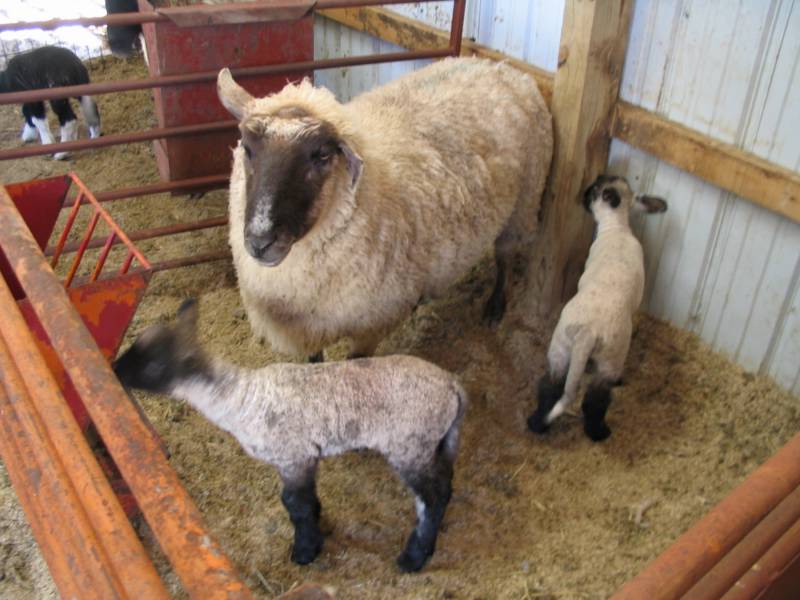
The lamb count is holding steady at four, two singles and a set of twins. All are looking good, but we are expecting many more. Lambing can be difficult, as witness the sight that met me yesterday. In a corner of the barn a ewe had left premature triplets. By the time I arrived, she had gone and there was no way of knowing whether they were still-born or just too early to survive outside the womb. The line between life and death can be very thin here on our hillside.
I am still working my way through The Best American Poetry 2004 anthology I mentioned below. So far I have read nothing worth quoting, though I still have a ways to go. However, after reading this review, I do not see much cause for optimism.

Sunday, January 09, 2005


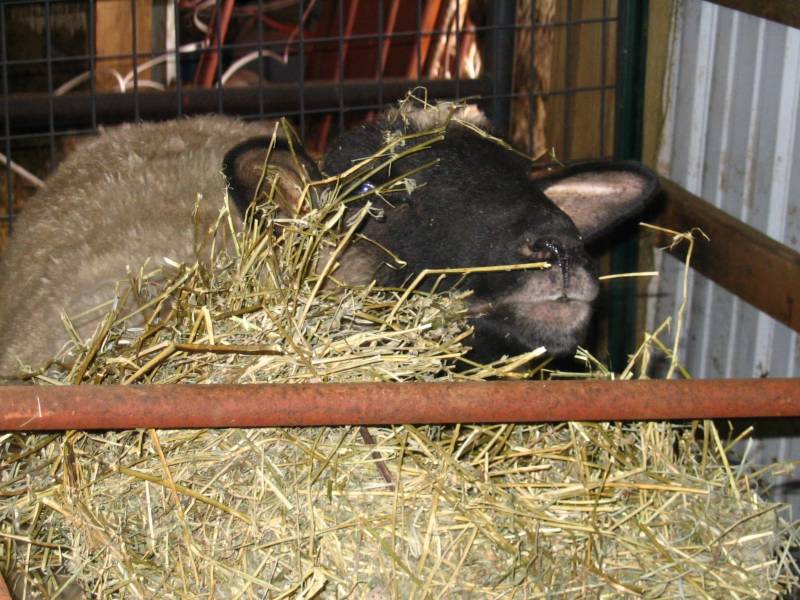
Nothing tops off a good sweet feed brunch like a little alfalfa in the feeder.

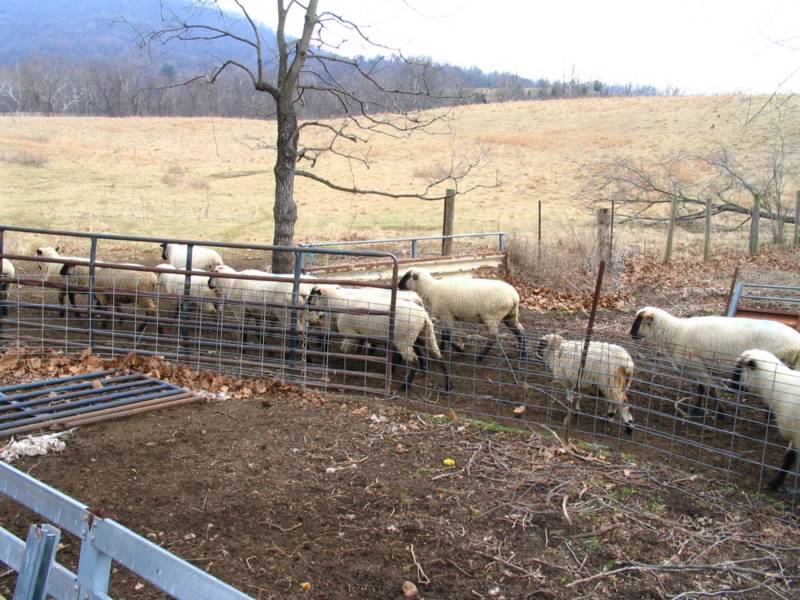
Luncheon over, the ladies leave.

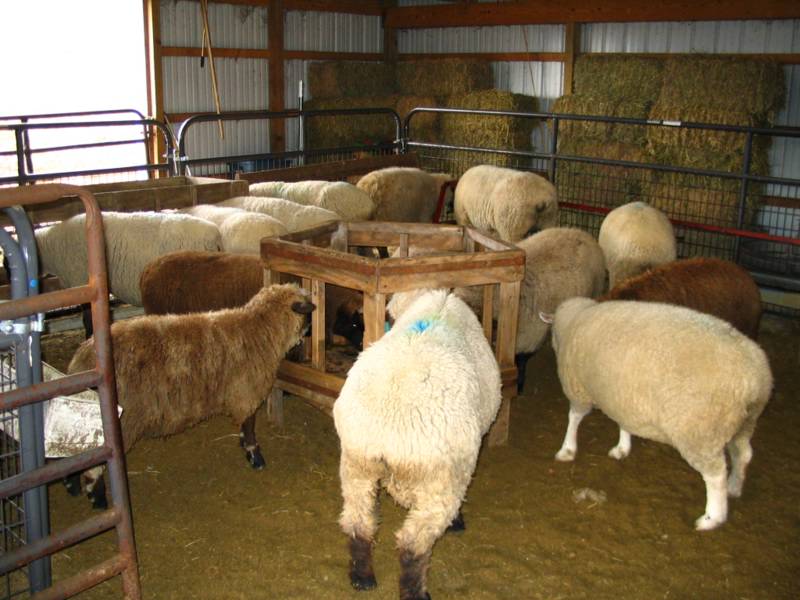
At the buffet line.

Sunday Brunch at the barn.

Saturday, January 08, 2005

Since our new arrivals were not interested in posing for a portfolio, I would suggest that you head over to the photoblog at A Walk Through Durham Township, Pennsylvania for your rural photo fix. Beautiful work.

More new lambs today. These twins came in from the field with their mother, healthy and very active. In fact, they didn't even want to sit still for a picture.

Friday, January 07, 2005

Besides regular blogging, I made two other resolutions this New Years. The first is to lose weight. I hit the half-century mark this summer, so the project is "back to 160 by 50." The second is to rein in my caffeine habit. I am one of those rare people who actually like the taste of coffee. I drink it black by preference, and am not adverse to straight shots of espresso. I will finish a meal at Cafe Sofia with a tiny cup of turkish coffee, basically grounds moistened with a little hot water. I think it is just great that coffee houses are springing up around every corner, even in a town like Front Royal. Stashed in and around various cupboards and counters at home are a french press, an espresso machine, and an automatic drip coffeemaker. All have seen heavy use in their time. There is something about that first cup in the morning; the aroma opening your senses while that first jolt of caffeine opens the brain's blood flow and starts the heart pumping fast enough to bring you awake at last. So, why the change? It is all National Geographic's fault. The most recent issue has a cover story on caffeine, which includes some brain scan photographs showing, quite graphically, that a heavy user's brain literally doesn't function properly without it. Hence my grand ambition to reduce consumption to a level which doesn't turn one's brain chemistry into a home science experiment.

I do not plan to give it up altogether, but rather to enjoy at a more moderate level, for as the poet Joseph Brodsky put it, "no century from now on will ever manage without caffeine or jazz ." So, tomorrow morning I plan on brewing my small pot, mostly decaf, with a little of the real stuff thrown in, and listen to Stan Getz playing tunes from Antonio Carlos Jobim on the stereo. Maybe I'll even read a little Brodsky before heading down to the sheep barn. Life is good, even with a little less stimulation in the cup.
Apropros of the previous post, Al Kimel at the Pontifications weblog has provided links to each step of the Mere Comments discussion here. Pontifications is well worth a read in its own right. The Rev. Kimel, an Episcopal priest, is simultaneously exploring the depths of Christian tradition, surveying the current Episcopal trainwreck, and encouraging a wide ranging dialogue in his comments section. The discussions are usually courteous, often passionate and always interesting. (I realize that theological discussion as a spectator sport is right up there with watching paint dry for some folks, so I should say, always interesting to me, and to you too, if you like that sort of thing.)

Thursday, January 06, 2005

David Bentley Hart, a personal favorite of mine among contemporary Orthodox theologians, wrote a piece recently for the Wall Street Journal responding to the question of where God was during the Indian Ocean tsunami. The Mere Comments weblog has been hosting an exchange between Hart and some critics. The end of the discussion can be found here. Links to the full discussion can be found here. If you follow the "trackback" link at the end of each post, it will lead you to further discussions spilling over on other weblogs, particularly here, where one of Hart's original respondents provides further thoughts on his own web page. While there is quite a bit of talking past one another, there are also intriguing forays into issues of evil, grace, sin and the nature of the universe.

Wednesday, January 05, 2005

If you check the archives of this site, you will find a number of classical Chinese poems translated by my friend Jonathan Chaves. Not being a speaker of the language myself, I rely on scholar-poets like Jonathan to give a taste in English of one of the world's great literatures. Even the best English translations can be misleading though. The Chinese classics come to us in English as free verse, tightly compressed, with striking images. What we monolinguals miss is that the Chinese originals were written in formal schemes of rhyme and word stress suitable for singing, in accordance with rules sometimes dating back a thousand years. While there are great translations out there, there has been little effort made convey this side of Chinese verse in English. Jonathan has been quietly working on more "formal" English translations of Chinese poems with the goal of expanding our experience of this great literature. As part of that effort he has been flexing his skills by writing light verse and topical satire, sort of a poet's warm up five finger exercise. At times though he takes on more serious subjects. It was traditional for Chinese poets to combine painting with writing, and the poem written in response to a painting (often inscribed on the painting itself) was an important part of the cultural dialogue. Jonathan has taken a step towards bringing this tradition into a western setting with Four Poems in Paint; a series of poems displayed together with the paintings that inspired them on the website for the online journal Praesidium.

Tuesday, January 04, 2005

I am a reader, and occasional purchaser, of contemporary poetry. That puts me in a group no larger than holding capacity of your average college stadium. Now if you wanted to gather the people who write poetry together, you would probably have to lease every facility in NFL for the weekend. But those of us who simply read, without being "in the business" as it were, are a vanishing small minority. If you doubt it, keep in mind that the average press run for a volume of new poems is in the range of one thousand to three thousand copies. The current estimated population of the United States is, as I write this, 295,186,847. You work out the percentage of the American public which can be expected to buy a new work of poetry. Nonetheless, poetry is one of the things I love, and I do my best as a reader and book buyer to support the work of living poets I admire.

The reason I bring this up is the book sitting on the top of the bedside reading shelves, The Best American Poetry 2004, courtesy of the local library. Every year, I helplessly pick up the latest installment in the series, drawn like Charlie Brown to Lucy holding that football. Every year I end up sorting through line after line of solipsistic nonsense by folks who seem actively hostile to the sound and rhythms of speech in English. Ah, but hope springs eternal. I will let you know how it goes with this year's volume, and will follow up with a list of a few contemporary poets I do enjoy.

In the meantime, you could do worse than spend some time with Dana Gioia's website. Beside being the current chairman of the National Endowment for the Arts, he is also a fine critic and poet in his own right. While you are there, be sure to read his 1991 essay, "Can Poetry Matter?"

Monday, January 03, 2005


The tragic reports and film footage coming in from the countries bordering the Indian Ocean serve as a reminder of the unexpected power of moving water. Right before Christmas, we had a line of thunderstorms accompanied by "significant wind gusts." What you see in the picture was our reminder of the unexpected power of moving air. While Susan watched, a pocket of 50 mph winds picked up the sheep shed and flipped it on its roof, taking out a big chunk of our fence in the process. No harm was done beyond the obvious damage, for which we are grateful.

Sunday, January 02, 2005


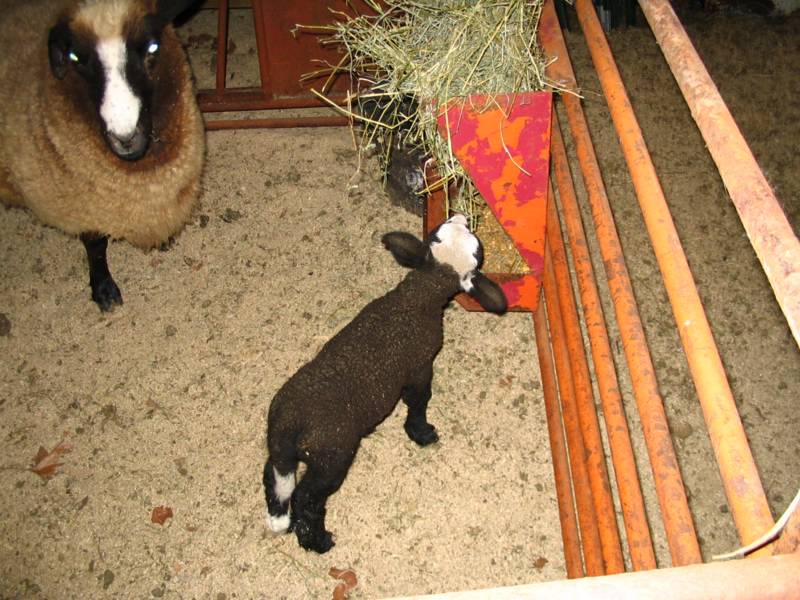
The first lamb of the season. The mother behind him is not actually possessed, though she is a little irritated. Lighting is tricky in the barn and the digital sometimes needs a flash fill when shooting in the dimmer corners. Unfortunately no one seems to have an automatic sheep "blue-eye" removal setting.

Sheep in Afternoon light