Saturday, August 09, 2003
Metropolitan Anthony of Sourozh, better known to readers of his books on prayer as Anthony Bloom, died on August 4th. His little book, Beginning to Pray, has been my constant companion for the last quarter century. I will reread parts of it tonight in honor of this good and wise man. Memory Eternal.


Friday, August 01, 2003
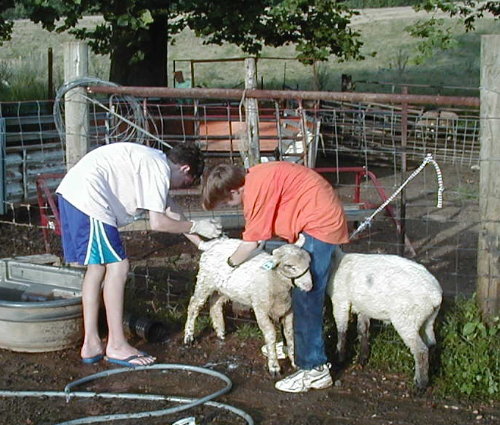
This Sunday marks the start of the Warren County Fair. The boys are washing sheep, getting them cleaned up for the 4-H show ring. I will have a booth in the "Wonder Building" kicking off my campaign for Commonwealth's Attorney. (That's chief local prosecutor, or "D.A." for you non-Virginians.) Stop by the show barn and greet the kids, then walk across the way and pick up a bumpersticker, get your hand shook and your baby kissed.

Monday, July 28, 2003
After a cold spring and colder winter, it comes as a shock to find ourselves (at last) in deep southern summer. Hot, and so humid the least effort leaves you dripping. As I was pounding in metal fence post stakes this weekend, rebuilding the fence between the barn and the little spring that feeds our brook, my thoughts turned to rest, shade and running water:

From time to time I use my friend Jonathan Chaves' wonderful translations of Chinese poetry on this site. Jonathan claims to be the world's only Jewish, Eastern Orthodox scholar of Classical Chinese literature. Like the Confucian poets he translates, he is also something of a philosopher. He has written a substantial exploration of epistemology titled Kicking the Stone and Viewing the Icon: Realist Epistemology Between Heaven and Earth, which is now online. Beginning with a quote from Chesterton, it spins through Aquinas, Dr. Johnson, early nineteenth century English novels, John of Damascus, Gregory Nanzianus, Gregory Palamas, and Vogelin, stopping along the way to examine the pernicious influence of both nominalism and deconstruction. It is worth your time if you are interested in such things.
Sunday, July 27, 2003
I have been reading lately in Powers of Heaven and Earth; New and Selected Poems, by John Frederick Nims. Here is a new favorite from the epigrams interspersed between his longer works:
Avant-garde
"A dead tradition! Hollow shell!
Outworn, outmoded--time it fell.
Let's make it new. Rebel! Rebel!"
Said cancer-cell to cancer-cell.
Reading Nims, whose published work spans from the forties until 1999, when he died, I realized that he has a characteristic that I miss in most of our contemporary writers; wit. In our post-modern age we have sarcasm, satire, and irony, but, rarely, wit. Wit shares in post-modernity's delight in word-play. Where wit parts with post-modernity is that wit assumes the existence of standards, of ideals, and skewers our failure to live up to them. In our post-modern days we, by contrast, seem to have come to the conclusion that, since no one lives up to an ideal, it is hypocrisy to hold one. Cleverly pointing out the gap between the real and the ideal is pointless, if ideals themselves are fictions promoted by the dominant class structure. Holding firmly to the existence of standards, wit plays in that gap between our actions and our best intentions. Here is another example from Nims:
Contemplation
"I'm Mark's alone!" you swore. Given cause to
doubt you,
I think less of you, dear. But more about you.
Here the poet makes a double-play, skewering both the narrator and the lady in question, as both fail to live up to the ideal of fidelity. The play of wit, of course, is not the same thing as actually repenting of our sins and hypocrisies. What use is it then? Perhaps it is as close as some of us can come to humility; recognizing our own sins as we smile at our neighbor's. As Nims says in another epigram, directed to
You Pious People
Most any sin--read Scripture if you doubt it--
'S forgiven sooner than righteousness about it.
Avant-garde
"A dead tradition! Hollow shell!
Outworn, outmoded--time it fell.
Let's make it new. Rebel! Rebel!"
Said cancer-cell to cancer-cell.
Reading Nims, whose published work spans from the forties until 1999, when he died, I realized that he has a characteristic that I miss in most of our contemporary writers; wit. In our post-modern age we have sarcasm, satire, and irony, but, rarely, wit. Wit shares in post-modernity's delight in word-play. Where wit parts with post-modernity is that wit assumes the existence of standards, of ideals, and skewers our failure to live up to them. In our post-modern days we, by contrast, seem to have come to the conclusion that, since no one lives up to an ideal, it is hypocrisy to hold one. Cleverly pointing out the gap between the real and the ideal is pointless, if ideals themselves are fictions promoted by the dominant class structure. Holding firmly to the existence of standards, wit plays in that gap between our actions and our best intentions. Here is another example from Nims:
Contemplation
"I'm Mark's alone!" you swore. Given cause to
doubt you,
I think less of you, dear. But more about you.
Here the poet makes a double-play, skewering both the narrator and the lady in question, as both fail to live up to the ideal of fidelity. The play of wit, of course, is not the same thing as actually repenting of our sins and hypocrisies. What use is it then? Perhaps it is as close as some of us can come to humility; recognizing our own sins as we smile at our neighbor's. As Nims says in another epigram, directed to
You Pious People
Most any sin--read Scripture if you doubt it--
'S forgiven sooner than righteousness about it.
Wednesday, July 23, 2003
If you have visited this site within the past twelve hours and found a rather different page than the one you were expecting, no I haven't headed in a radically new direction. Blogger appeared to go insane for a while and linked my url to someone else's page. I hope everything is fixed. While the page has not undergone a full metamorphosis, I am doing a little housecleaning on the site. The links on the left are undergoing a long overdue sorting and updating. If you would like a link on the site and I haven't put you in yet, let me know. The categories are somewhat arbitrary and subject to change, so if you don't like where I've put you, shout out and I'll try to find a more congenial pigeonhole.
Saturday, July 19, 2003
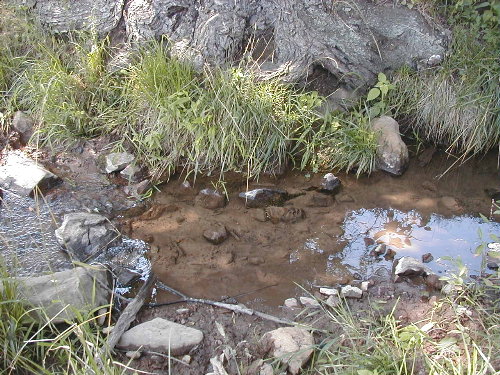
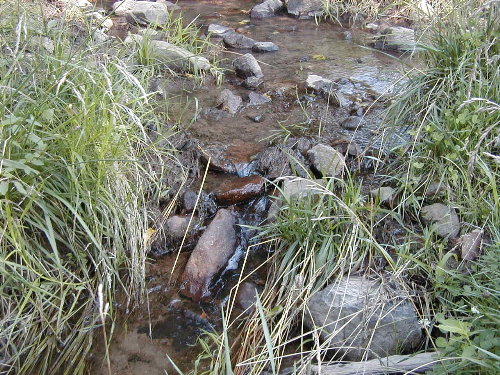
Easy-flowing brook,
Hushed--till root or rock impede.
Then it learns to sing.
Ragdale Haiku, John Frederick Nims
Tuesday, July 15, 2003
The shepherdess nuns at Holy Myrhbearers Monastery have updated the page for Maude, their spokessheep. If you like the photos on this site, go take a look at the wonderful pictures of the new additions to their flock. While you are there, stop by the online store and pick up something. Like most monastics, the sisters try and support themselves with the labor of their own hands. The sisters publish a small review twice yearly, "Essays and Notes," which is always worth reading. Mother Raphaela's essays exhibit a deep spirituality combined with that rarest of virtues in the religous life, common sense. Click on the link for samples, or, better yet, buy her first collection Living in Christ and support the sisters' work.
Saturday, July 12, 2003
I have little enough time these days to update one weblog, so of course, I have now started a second. It too, I expect will see sporadic updates. Here is the intro to the new site:
Sometime back I had planned on adding a regular feature on Orthodox spirituality in our contemporary culture to my Notes From a Hillside Farm weblog. As that site has developed, it no longer seems an appropriate forum for longer pieces. So now I would like to introduce "son" of Hillside Farm; The Suburban Ascetic. This site, as the subtitle suggests, will be a place to put occasional longer pieces on Orthodox spiritual life lived, not in monasteries or some dream of Byzantium or Holy Russia, but in contemporary America. By way of a beginning, I have reposted some thoughts on the Jesus Prayer, originally written on Hillside Farm a year ago.
Sometime back I had planned on adding a regular feature on Orthodox spirituality in our contemporary culture to my Notes From a Hillside Farm weblog. As that site has developed, it no longer seems an appropriate forum for longer pieces. So now I would like to introduce "son" of Hillside Farm; The Suburban Ascetic. This site, as the subtitle suggests, will be a place to put occasional longer pieces on Orthodox spiritual life lived, not in monasteries or some dream of Byzantium or Holy Russia, but in contemporary America. By way of a beginning, I have reposted some thoughts on the Jesus Prayer, originally written on Hillside Farm a year ago.
Visitor

Redsox, the sheep pictured above, was a bottle lamb, born half-dead and brought back to life by my wife with "mouth to snout resuscitation." She spent her first few weeks being bottle fed in a box in the basement intensive care ward. To our amazement, she survived and thrived. When she was older she used the children's small plastic playhouse as a barn, growing strong enough on a diet of front yard grass and Susan's back yard roses to rejoin the flock. She adapted to life as a regular sheep quite well, though she still comes up to see us, her first flock, when we are out by the pasture.
Redsox, the sheep pictured above, was a bottle lamb, born half-dead and brought back to life by my wife with "mouth to snout resuscitation." She spent her first few weeks being bottle fed in a box in the basement intensive care ward. To our amazement, she survived and thrived. When she was older she used the children's small plastic playhouse as a barn, growing strong enough on a diet of front yard grass and Susan's back yard roses to rejoin the flock. She adapted to life as a regular sheep quite well, though she still comes up to see us, her first flock, when we are out by the pasture.

Thursday, July 10, 2003
Morning mist and trespassing ewes
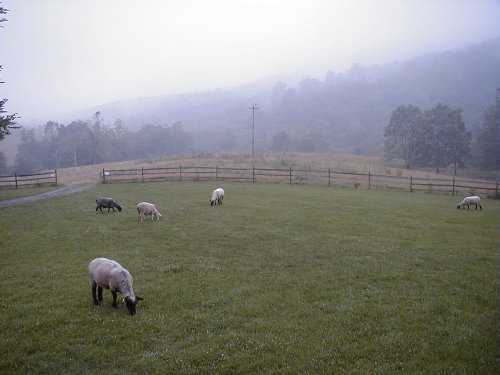
This year has been hard on the sheep flock. A harsh winter followed by the wettest spring in recent memory has stressed lambs and ewes alike. The pastures, while green enough, are getting choked with weed and thistle who have formed a kind of vegetable mob, rioting in the wet fields. The ladies pictured above picked their way across the cattle guard, filled in with gravel wash from the latest downpours, to get at the more well-mannered grass in the yard. With all the labor and losses we have gone through together this spring, I didn't have the heart to chase them out. I left them to their breakfast as I went to pour the morning coffee.
This year has been hard on the sheep flock. A harsh winter followed by the wettest spring in recent memory has stressed lambs and ewes alike. The pastures, while green enough, are getting choked with weed and thistle who have formed a kind of vegetable mob, rioting in the wet fields. The ladies pictured above picked their way across the cattle guard, filled in with gravel wash from the latest downpours, to get at the more well-mannered grass in the yard. With all the labor and losses we have gone through together this spring, I didn't have the heart to chase them out. I left them to their breakfast as I went to pour the morning coffee.
Sunday, June 15, 2003
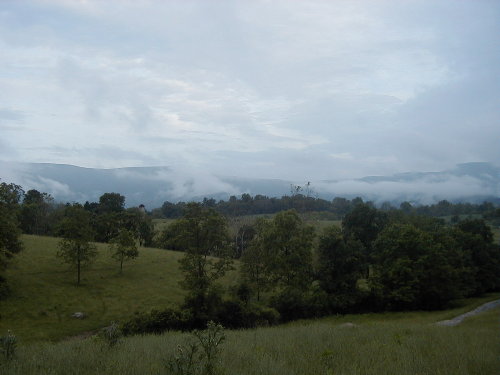
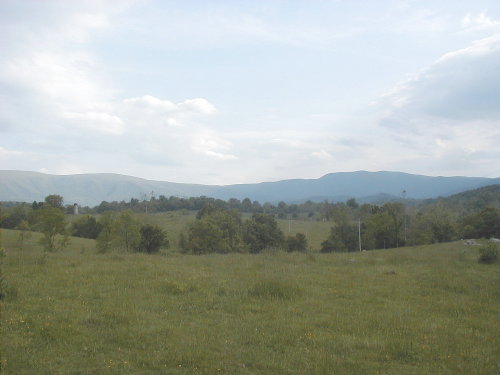
This is the summer of rain. I heard a local forecaster announce recently that the last time we had three consecutive sunny days was in April. Our farm has become like that place for which the local weather wisdom summed up all possible conditions by saying, "If you can see the mountains, you know it's going to rain. If you can't see the mountains, it's raining." Here are two pictures of our mountains taken this weekend to illustrate the point.

Sunday, June 01, 2003
Daniel asked in a comment below, "[W]hat does the Orthodox Church teach concerning the eternality, if any, of animals?" It is something I have thought about myself. The Scriptures and the Tradition are not overflowing with information on the subject. The great vision of the New Jerusalem in Saint John's Apocalypse is strangely silent on the fate of these companions of ours for whom we struggle and pour out our care, and who, sometimes, provide our sustenance. For a vision of animals and the Kingdom, we must go back to the Prophet Isaiah:
The wolf shall dwell with the lamb, and the leopard shall lie down with the kid, and the calf and the lion and the fatling together, and a little child shall lead them. The cow and the bear shall feed; their young shall lie down together; and the lion shall eat straw like the ox. The sucking child shall play over the hole of the asp, and the weaned child shall put his hand on the adder's den. They shall not hurt or destroy in all my holy mountain; for the earth shall be full of the knowledge of the LORD as the waters cover the sea.
Isaiah 11 6-9.
The vision of Isaiah encompasses a renewed Creation where other creatures, themselves renewed, have a place. It does not answer however, the question of the fate of individual animals. Do all dogs go to heaven? We do not know. What we do know is that all things are embraced by the love of God who keeps track of the fall of a single sparrow. In Orthodoxy, when we wish to know what God is like, and to understand what God is doing, we can look to the Saints, those men and women who lived in close communion with God. The goal of Orthodox spirituality is theosis, a participation in the life of the Trinity, whereby men and women become God-like, or as the Tradition sometimes puts it, "gods by grace." One ancient Saint that many modern Orthodox turn to as a kind of touchstone for the spiritual life is Isaac the Syrian. He had this to say about the nature of the person who has made the Divine compassion his own:
An elder once asked, 'What is a compassionate heart?'. He replied: 'It is a heart on fire for the whole of creation, for humanity, for the birds, for the animals, for demons and for all that exists. At the recollection and at the sight of them such a person's eyes overflow with tears owing to the vehemence of the compassion which grips his heart; as a result of his deep mercy his heart shrinks and cannot bear to hear or look on any injury or the slightest suffering of anything in creation. 'This is why he constantly offers up prayer full of tears, even for the irrational animals and for the enemies of truth, even those who harm him, so that they may be protected and find mercy. 'He even prays for the reptiles as a result of the great compassion which is poured out beyond measure- after the likeness of God- in his heart'.
From 'DAILY READINGS WITH ST. ISAAC OF SYRIA'- 1990 Templegate Publishers, Springfield, ILL
If the compassion of the Saints is such, how can we doubt the compassion of the God whose likeness they bear? While I know of no specific revelation concerning the animals we have loved, I do know from the Orthodox Tradition, that in God's mercy, no love is ever wasted.
The wolf shall dwell with the lamb, and the leopard shall lie down with the kid, and the calf and the lion and the fatling together, and a little child shall lead them. The cow and the bear shall feed; their young shall lie down together; and the lion shall eat straw like the ox. The sucking child shall play over the hole of the asp, and the weaned child shall put his hand on the adder's den. They shall not hurt or destroy in all my holy mountain; for the earth shall be full of the knowledge of the LORD as the waters cover the sea.
Isaiah 11 6-9.
The vision of Isaiah encompasses a renewed Creation where other creatures, themselves renewed, have a place. It does not answer however, the question of the fate of individual animals. Do all dogs go to heaven? We do not know. What we do know is that all things are embraced by the love of God who keeps track of the fall of a single sparrow. In Orthodoxy, when we wish to know what God is like, and to understand what God is doing, we can look to the Saints, those men and women who lived in close communion with God. The goal of Orthodox spirituality is theosis, a participation in the life of the Trinity, whereby men and women become God-like, or as the Tradition sometimes puts it, "gods by grace." One ancient Saint that many modern Orthodox turn to as a kind of touchstone for the spiritual life is Isaac the Syrian. He had this to say about the nature of the person who has made the Divine compassion his own:
An elder once asked, 'What is a compassionate heart?'. He replied: 'It is a heart on fire for the whole of creation, for humanity, for the birds, for the animals, for demons and for all that exists. At the recollection and at the sight of them such a person's eyes overflow with tears owing to the vehemence of the compassion which grips his heart; as a result of his deep mercy his heart shrinks and cannot bear to hear or look on any injury or the slightest suffering of anything in creation. 'This is why he constantly offers up prayer full of tears, even for the irrational animals and for the enemies of truth, even those who harm him, so that they may be protected and find mercy. 'He even prays for the reptiles as a result of the great compassion which is poured out beyond measure- after the likeness of God- in his heart'.
From 'DAILY READINGS WITH ST. ISAAC OF SYRIA'- 1990 Templegate Publishers, Springfield, ILL
If the compassion of the Saints is such, how can we doubt the compassion of the God whose likeness they bear? While I know of no specific revelation concerning the animals we have loved, I do know from the Orthodox Tradition, that in God's mercy, no love is ever wasted.

Wednesday, May 28, 2003
Our Memorial Monday Shearing Marathon went the way of "the best-laid schemes o' mice an 'men", when we discovered that the sheep, members of a species not noted for manual dexterity, had managed to unhook the chain on the barn gate. Pushing open the now unsecured gate, they headed out to pasture just in time for an early morning rainstorm to turn their dry coats into a sodden, unshearable mess. I shouldn't have been surprised. A single sheep is, by definition, an accident waiting to happen. Several sheep are a chain of accidents waiting to happen. Putting seventeen together in an enclosed area has the same effect on the laws of probability that a black hole has on the laws of physics. One can only look on with a kind of despairing awe while muttering "no, that's just not possible."
Faced with an empty barn and a field full of walking wet wool, we gave up on shearing and decided to inspect the remainder of this year's lambs. After a few sales, and some losses due to the hard winter, we still have over forty running around the place. We selected five of the larger ones to go off to the auction in Winchester this morning to help cover the winter feed bills. Selling lambs is the point of the enterprise, but it still hurts a little every time we load the truck. Last year we reduced the size of the flock by half and selection was one of the hardest things we have done on the farm. One old ewe, a favorite of my wife's, had not had a lamb in two years. Making the rational economic decision, we tagged to her to go. As we were loading the trailer, she stepped out of the flock and walked over to my wife to greet her and have her chin scratched. She is still with us. She made it through the worst of the Winter, but will probably not last until Summer. Age has caught up with her and the decline has been rapid. For the last day or so, she has been resting near the fence, in a spot shaded in the day, out of the worst of the rain. There is good grass within easy reach and the rest of the flock is in view. I checked on her this evening and she was too weak to stand. I made her as comfortable as possible as we wait.
Faced with an empty barn and a field full of walking wet wool, we gave up on shearing and decided to inspect the remainder of this year's lambs. After a few sales, and some losses due to the hard winter, we still have over forty running around the place. We selected five of the larger ones to go off to the auction in Winchester this morning to help cover the winter feed bills. Selling lambs is the point of the enterprise, but it still hurts a little every time we load the truck. Last year we reduced the size of the flock by half and selection was one of the hardest things we have done on the farm. One old ewe, a favorite of my wife's, had not had a lamb in two years. Making the rational economic decision, we tagged to her to go. As we were loading the trailer, she stepped out of the flock and walked over to my wife to greet her and have her chin scratched. She is still with us. She made it through the worst of the Winter, but will probably not last until Summer. Age has caught up with her and the decline has been rapid. For the last day or so, she has been resting near the fence, in a spot shaded in the day, out of the worst of the rain. There is good grass within easy reach and the rest of the flock is in view. I checked on her this evening and she was too weak to stand. I made her as comfortable as possible as we wait.
Sunday, May 25, 2003
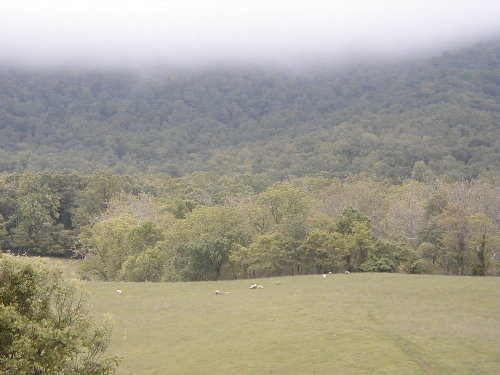
I would put up a new picture today, except that last Sunday's still serves very well. We have had more rain in the last few weeks than we did in the months of June and July last Summer. Already the light greens of Spring have given way to something darker and more lustrous. The ground squishes when you walk in low lying areas. The pasture springs that feed into Gooney Run at the foot of our hill are flowing freely. If I am quiet, I can hear the sound of rushing water all the way up at the house. The end of May is normally sheep shearing time, but that has been delayed as our flock walks in knee high wet pastures, rain soaking into their thick, sodden wool coats.
Yesterday we took advantage of a break between showers to put seventeen ewes from the flock into the barn to dry out for a Memorial Day Morning Shearing Marathon. A professional could shear our entire flock (well over a hundred, counting this year's lambs) in a day. We move a bit slower, taking a while to get up to speed each year. My wife is also very picky about her girls' appearance after their annual cut, and spends extra time on each to make sure they look sharp before they head back out to the pasture.
Some of the sheep take very well to the process, and seem relieved to have winter's wool off as summer's heat kicks in. Others want nothing to do with it and fight you every step of the way. It has to be done though, as they would be dead from heat exhaustion by August if we let them keep their coats. The yearlings are the worst. Imagine a hundred and fifty pound toddler getting his first haircut and you begin to get the idea. My back hurts just thinking about it.
Some years we actually have a volunteer or two come out for a real hands-on farming experience. There are some things that they don't have the experience to do, but extra hands are always welcome. There is an art to shearing in the traditional fashion that involves throwing, balancing and turning the sheep as much as it does actually using the clippers. We shear a few of the flock that way, but in the interest of being able to stand up and function at our day jobs, most of the flock will be cranked up on a show stand and trimmed out with a minimum of bending and turning. It is slower, but easier on the shearer. It also makes it possible for the amateur volunteer to help without immanent disaster involving escaping sheep, power cords, and sharp blades on electric shears.
We will be at it most evenings and weekends for the next couple of weeks. Come on out and lend a hand!
Yesterday we took advantage of a break between showers to put seventeen ewes from the flock into the barn to dry out for a Memorial Day Morning Shearing Marathon. A professional could shear our entire flock (well over a hundred, counting this year's lambs) in a day. We move a bit slower, taking a while to get up to speed each year. My wife is also very picky about her girls' appearance after their annual cut, and spends extra time on each to make sure they look sharp before they head back out to the pasture.
Some of the sheep take very well to the process, and seem relieved to have winter's wool off as summer's heat kicks in. Others want nothing to do with it and fight you every step of the way. It has to be done though, as they would be dead from heat exhaustion by August if we let them keep their coats. The yearlings are the worst. Imagine a hundred and fifty pound toddler getting his first haircut and you begin to get the idea. My back hurts just thinking about it.
Some years we actually have a volunteer or two come out for a real hands-on farming experience. There are some things that they don't have the experience to do, but extra hands are always welcome. There is an art to shearing in the traditional fashion that involves throwing, balancing and turning the sheep as much as it does actually using the clippers. We shear a few of the flock that way, but in the interest of being able to stand up and function at our day jobs, most of the flock will be cranked up on a show stand and trimmed out with a minimum of bending and turning. It is slower, but easier on the shearer. It also makes it possible for the amateur volunteer to help without immanent disaster involving escaping sheep, power cords, and sharp blades on electric shears.
We will be at it most evenings and weekends for the next couple of weeks. Come on out and lend a hand!
Sunday, May 18, 2003
Subscribe to:
Posts (Atom)