Thursday, April 06, 2006
The "Crunchy Con" blog discussion I linked to last week has wrapped up. Rod Dreher, the author of the book behind the blog ends it with the words; "Anyway, so long, and thanks for all the granola. Stagger onward rejoicing!" referencing both Douglas Adams and W. H. Auden. I had adopted the Auden quote as my own theme for Lent, so was delighted to see it. Auden has been showing up a lot in my reading and listening of late. In Dana Gioia's talk linked in Sunday's post he recites another Auden poem, As I Walked Out One Evening, which contains the wonderful line "You shall love your crooked neighbour / With your crooked heart." I will add this to the first quote as a theme for the remainder of Lent.


Wednesday, April 05, 2006

Tuesday, April 04, 2006
Monday, April 03, 2006
Sunday, April 02, 2006
A number of years ago when I was on the vestry of our local Episcopal Church I helped put together a Lenten lecture and performance series on Christianity and the Arts. I called in some favors from friends and acquaintances who were singers, painters, playwrights and scholars who did some remarkable presentations. I have continued to be interested in the theme and was delighted to run across this group; The International Arts Movement, which describes itself as
"a catalyst arts organization committed to cultural and spiritual renewal. Its programs support individual artists in their work and embrace the entire arts community. IAM is active in Tokyo and New York City, with affiliations in Orlando, Los Angeles, and London. Its vision: a fusion of creativity and faith that expresses and illustrates God's intimate and merciful identity in the world. "
They are offering a free mp3 download via iTunes of Poet and NEA Chairman Dana Gioia's keynote address at their recent Artist as Reconciler conference. The founder of IAM, artist and Christian convert Makoto Fujimura has his own web page with links to his paintings, essays and weblog.
"a catalyst arts organization committed to cultural and spiritual renewal. Its programs support individual artists in their work and embrace the entire arts community. IAM is active in Tokyo and New York City, with affiliations in Orlando, Los Angeles, and London. Its vision: a fusion of creativity and faith that expresses and illustrates God's intimate and merciful identity in the world. "
They are offering a free mp3 download via iTunes of Poet and NEA Chairman Dana Gioia's keynote address at their recent Artist as Reconciler conference. The founder of IAM, artist and Christian convert Makoto Fujimura has his own web page with links to his paintings, essays and weblog.
Saturday, April 01, 2006
For today's entry we return to In the Service of the King. It comes from a portion of the book where the author was serving as a deacon, leading Morning Prayer and preaching in a country parish where he traveled by buggy between the five churches in his charge.
But above all the rewards of his early ministry he holds the experience of that Sunday, when, for the encouragement of the truest-hearted gentleman he ever knew, he preached a sermon. This was a man who, in the midst of a losing fight with fortune, fought on with quivering lip from which no plaint ever came; whose gracious courtesies in the home, whose simple services of neighborly helpfulness, and whose hatred of a lie marked him as a man after God's own heart. The sermon was on Isaac, the commonplace man; the man without executive ability, the unprogressive son of a masterful father, but withal a good neighbor, a good husband, and one who found his place in the eleventh chapter of Hebrews, God's own Westminster. When the service was over, and the deacon had just retired to the robing-room, the living Isaac of the parable opened the door, and gowned as he was, the deacon found himself lifted from his feet and held tight in the bear-like hug of his friend, who, after he had set him down, left without a word.
Friday, March 31, 2006
Apropos of Wednesday's post, I began the day by driving over to the other half of the farm to rescue a sheep that had gotten herself tangled in some old barbed wire. You have to picture this. The barbed wire is part of an old fence line, cut and coiled against a tree jutting out from some rocks in the hillside, with one end of the wire still tacked to the tree. The sheep managed to find this one spot in the midst of a hundred acres and then succeeded in getting her head through the coil , looping barbed wire twice around her neck, once across her body and embed several small loops in the wool on her backside. All without once puncturing her skin. She is one of our wilder ewes, and when she saw me coming to her rescue, she started running around the tree, carrying the wire with her about knee high. She circled and I jumped, hopping foot to foot, playing double-dutch with rows of sheep motivated rusty spiked wire, chasing after her, cursing myself for forgetting my work gloves and trying to remember when I had my last tetanus shot. After several close calls for both of us, she snagged herself on some rocks and I was able to pin her down well enough to untangle the barbs from her wool. After she was freed she headed off back towards the barn without so much as a thank you or even a glance backward. It was one of those days where I have to agree with eldest son when he says, "Face it Dad, sheep are just stupid."
Thursday, March 30, 2006
National Review On-line has been hosting a blog discussing a new book by columnist Rod Dreher: Crunchy Cons: How Birkenstocked Burkeans, gun-loving organic gardeners, evangelical free-range farmers, hip homeschooling mamas, right-wing nature lovers, and their diverse tribe of countercultural conservatives plan to save America (or at least the Republican Party). The discussion has been vigorous and sometimes heated as the participants discover that while they all may be "conservatives," they are trying to conserve very different things. An interesting journey back to first principles in a time of political expediency. If you find yourself uneasy with the offerings of the two major parties, you might find the discussion worthwhile.
Wednesday, March 29, 2006
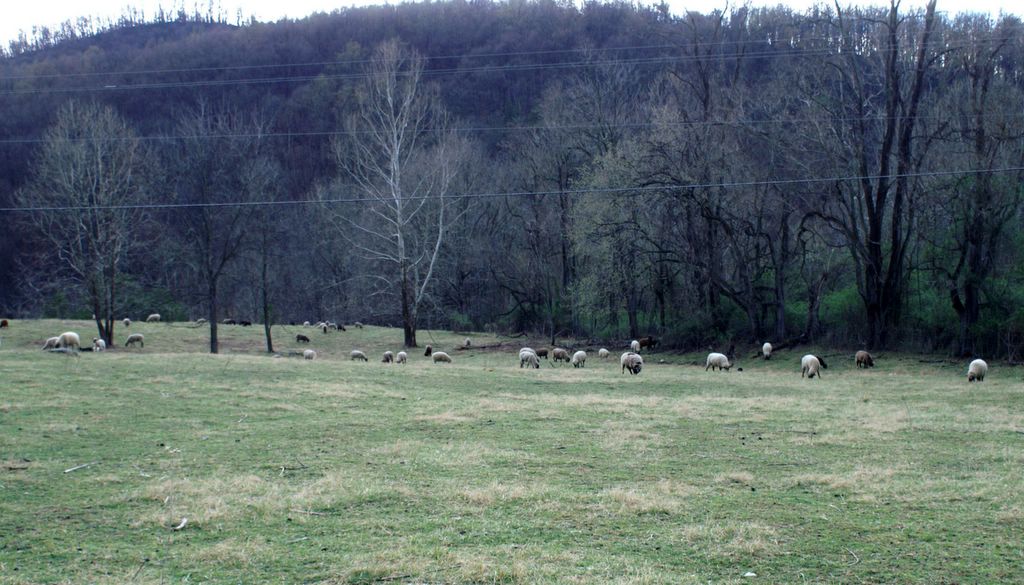
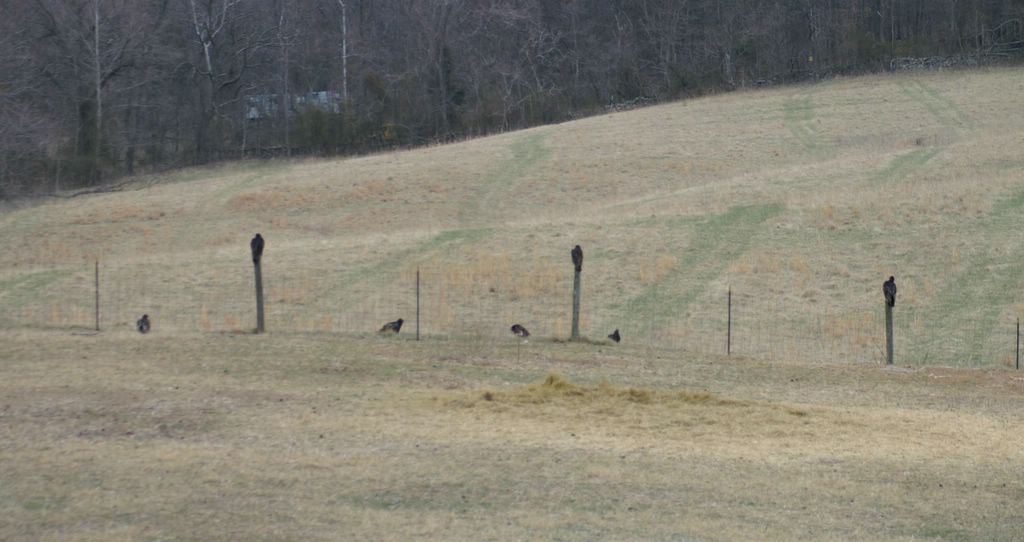
This morning, while on the way out to an early appointment, I saw vultures squatting on the banks of the little creek that trickles down from our spring into Gooney Run. Since vultures are not noted as aquatic birds, this was not a good sign. Sure enough, one of our ewes was down in the creek, and, from the amount of vulture activity, there did not seem to be much to be done except carry her off for a slightly more dignified and less public disposal. I continued on my way and on returning a short time later, looked up to see about nine vultures in a nearby tree, with four more pacing impatiently on the bank. I walked over to see what was holding them off and found an enormous red-tailed hawk perched on the side of the sheep, which had now formed a small white island in the creek, water backing up behind and flowing around her. The hawk and buzzards scattered as I approached and hauled the carcass out of the water, leaving it on the bank until we could get down with the farm truck.
What happened to her and how did she die? I don't know, and after our flying scavengers had helped themselves, much of the evidence was gone. With sheep it could be almost anything. Sometimes I think they do it as a kind of hobby, there being nothing much else happening in the pasture. There is a cowboy poet who laid out the unvarnished truth in one of his opuses:
Of all God's creatures in this world,
And I can't tell you why,
None can match a woolly sheep
When it comes to ways to die.
. . . (Here follow fifteen stanzas laying out in detail how his sheep have shuffled off this mortal coil. The first time I read the poem I showed it to my wife and said "See! It's not just us!). . .
Yep, sheep're the only critters I know
Who see life with a Kevorkian view.
Why go to the effort of living
When dying's so much easier to do?
From Woolly Ways to Die by Milo Yield.
What happened to her and how did she die? I don't know, and after our flying scavengers had helped themselves, much of the evidence was gone. With sheep it could be almost anything. Sometimes I think they do it as a kind of hobby, there being nothing much else happening in the pasture. There is a cowboy poet who laid out the unvarnished truth in one of his opuses:
Of all God's creatures in this world,
And I can't tell you why,
None can match a woolly sheep
When it comes to ways to die.
. . . (Here follow fifteen stanzas laying out in detail how his sheep have shuffled off this mortal coil. The first time I read the poem I showed it to my wife and said "See! It's not just us!). . .
Yep, sheep're the only critters I know
Who see life with a Kevorkian view.
Why go to the effort of living
When dying's so much easier to do?
From Woolly Ways to Die by Milo Yield.
Tuesday, March 28, 2006
During Lent the Eastern Churches go to a collection called the Triodion for special additions to the daily and weekly cycle of prayers and services. There are several translations of this material in English. Archimandrite Ephraim of the monastery of St. Andrew in England has placed his own versions on-line as part of his growing collection of translations into English. A little closer to home, the sisters of the Holy Myrrhbearers Monastery in upstate New York post daily excerpts from their own translation of the Triodion here. Here is an excerpt from today's Vespers service:
I surpass the publican in transgressions,
but do not even compete in his repentance!
I have not accomplished the good deeds of the Pharisee,
yet I boldly out-do his boasting!
By Your infinite humility, Christ God
through which You laid low the high-minded demons on the Cross,
establish in me the good deeds of the one,
and the humility of mind of the other,
confirming in me the good intentions of each,
and save me, O Savior!
Monday, March 27, 2006
Yesterday was the Third Sunday in Lent, the Sunday of the Cross. As Father Alexander Schmemann describes it:
[T]he Cross is brought in a solemn procession to the center of the church and remains there for the entire week--with a special rite of veneration following each service. It is noteworthy that the theme of the Cross which dominates the hymnology of that Sunday is developed in terms not of suffering but of victory and joy. . . . The meaning of all this is clear. We are in Mid-Lent. On the one hand, the physical and spiritual effort, if it is serious and consistent, begins to be felt, its burden becomes more burdensome, our fatigue more evident. We need help and encouragement. On the other hand, having endured this fatigue, having climbed the mountain up to this point, we begin to see the end of our pilgrimage, and the rays of Easter grow in their intensity.
In our little congregation in Winchester we approached the cross set on a table in the center of the Church and surrounded by flowers. As we venerated the symbol of our salvation, we each received a few daffodils, in anticipation of the joy of the resurrection that meets us at the end of Lent. What follows is a little piece of liturgical drama that forms part of one of the hymns sung at Matins on the Sunday of the Cross. Hell itself cries out as the Cross of Christ undoes the fall of Adam.
[T]he Cross is brought in a solemn procession to the center of the church and remains there for the entire week--with a special rite of veneration following each service. It is noteworthy that the theme of the Cross which dominates the hymnology of that Sunday is developed in terms not of suffering but of victory and joy. . . . The meaning of all this is clear. We are in Mid-Lent. On the one hand, the physical and spiritual effort, if it is serious and consistent, begins to be felt, its burden becomes more burdensome, our fatigue more evident. We need help and encouragement. On the other hand, having endured this fatigue, having climbed the mountain up to this point, we begin to see the end of our pilgrimage, and the rays of Easter grow in their intensity.
In our little congregation in Winchester we approached the cross set on a table in the center of the Church and surrounded by flowers. As we venerated the symbol of our salvation, we each received a few daffodils, in anticipation of the joy of the resurrection that meets us at the end of Lent. What follows is a little piece of liturgical drama that forms part of one of the hymns sung at Matins on the Sunday of the Cross. Hell itself cries out as the Cross of Christ undoes the fall of Adam.
Pilate set up three crosses in the place of the Skull, two for the thieves and one for the Giver of Life. Seeing Him, hell cried to those below: "O my ministers and powers! Who is this that has fixed a nail in my heart? A wooden spear has pierced me suddenly, and I am torn apart. Inwardly I suffer; anguish has seized my belly and my senses. My spirit trembles, and I am constrained to cast out Adam and his posterity. A tree brought them to my realm, but now the Tree of the Cross brings them back again to Paradise."
Sunday, March 26, 2006
Saturday, March 25, 2006
Friday, March 24, 2006
I grew up fishing and hunting with my grandfather who loved the outdoors so much that he infected his son-in-law, my father, with the habit and did his best to pass it on to me. I have not hunted in many years and it has been far too long since the fishing rods in the basement have seen open water. Perhaps as spring approaches I will clean up the tackle and take my own sons out on the Shenandoah in memory of my father, grandfather, and the old "parson" who started it all.
The parson spent too much time in fishing, perhaps; but his memory at least is unregenerate; for he looks back upon that time spent in fishing as among the golden hours of life. He learned to know the woods and waters. He knew every hole of mink and otter in many miles. He knew the hillside where the first arbutus bloomed. He violated the game laws by shooting muskrats by moonlight, and argued questions of theology with a fine old preacher of another Church, who was such an enthusiastic fisherman that he would put on a small hook and fish in the bait bucket while the bacon was being fried for dinner. The parson still contends that fishing is the one democratic sport. He likes fishing for the same reason that Pat likes a street fight. "I dearly love a street fight," said Patrick, "for in a street fight, one man is just as good as another, and sometimes a blamed sight better." He has prayed for all sorts and conditions of men, and fished with them, too; and he has seen a reprobate, whom no man would trust for quarter, turn the boat, so that the other fellow could get the best fishing. Such a man only lacked training and opportunity to become a hero.
Thursday, March 23, 2006
A long day today, so I turn again to In The Service of the King: A Parson's Story by Joseph B. Dunn. Tonight's excerpt shows that in spite of all the changes in education in the last hundred years, the student of the late nineteenth century is not that different from the student of the early twenty-first:
It is a strange fact that everything in the course, being held in memory by the fixed effort of the will, till returned to the professor and receipted for on a sheep-skin, promptly disappeared from his mind never to come back. The things he once knew best, he knows now not at all; and he is conscious that in his brain there are spots, now permanently barren, where the highest-priced knowledge obtainable once flourished for a season. The parson had been a student for thirty odd years. Half that period was spent not in tutelage, but in serfdom. Even now, when he has been out of school almost as long as he was in it, the form which the night-mare most frequently takes is the inquisitorial agony of the examination room.
The parson is persuaded that the ordinary diploma is nothing more or less than an honorable discharge from the ranks of learning on account of permanent disabilities.
Wednesday, March 22, 2006
Having re-read my great-grandfather's book, I may post portions of it here. This evening I give you the his opening lines which explain in short why I blog:
Some critic has said that the world is over-rich in the records of life's successes, that everybody knows the psychology of success, but that literature is actually in need of candid autobiographies of mediocrity. Satiated with the glare of bright colours, the reading public is eager for a drab literature. The tired ear longs for the droning monotone of Martin Tupper.
These reminiscences will appeal to tired minds alone. It is a journey through a flat country. There are plenty of resting-places, and the weary reader is not called upon to climb the hill of vision.
Tuesday, March 21, 2006
I had ordered a copy of a book by one of my great-grandfathers, the Rev. Joseph B. Dunn. It is a memoir of his life as an Episcopal minister in rural and small town Virginia at the turn of the century found on-line from a used book seller. It was waiting for me when I got home, a little battered from its travels from G. P. Putnam's Sons press where it was printed in 1915 until its arrival here this afternoon. So this evening will be spent with pen knife in hand opening the uncut pages and journeying in the company of my grandfather's father.
Monday, March 20, 2006
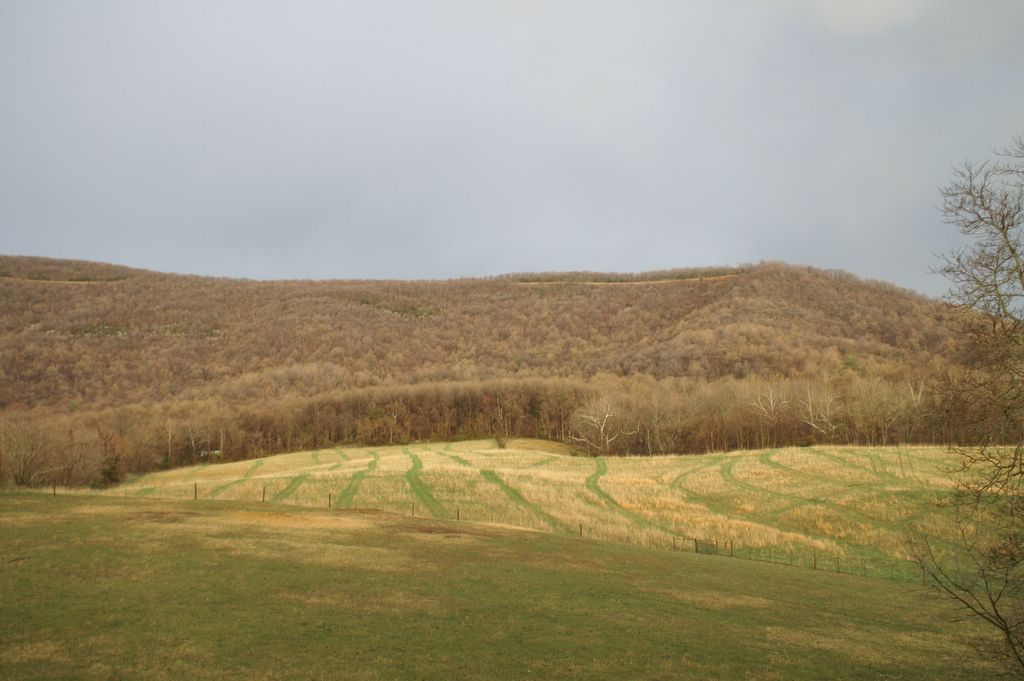
Our place here is on the edge of metro area sprawl. It makes for an odd mixture of rural and suburban. The surrounding mountains cut off most tv and cell phone reception. There are no water or sewer connections and we are our own trash service. At the same time, I am writing this on a high-speed cable cable modem courtesy of our cable tv company whose connections are strung below the power lines on the poles that march across the fields outside my window. It is, as I said, an odd mix that I tend to take for granted. After the evening feeding at the barn I find it as easy as anyone to escape into cyber-space or watch time tick by while gazing slack-jawed at a tv screen.
Nonetheless, the lack of certain services inevitably brings the real world crashing back in. A power failure means, not just lights out for a while, but no working well pump and soon thereafter no working indoor plumbing. Even if the grid stays up pretty reliably, dealing with your own trash on a regular basis keeps you grounded. We had a problem with the farm truck, our normal hauler to the county dump, and things had piled up a bit. When younger son and I got everything loaded and off on Saturday, the bags, boxes and other detritus of modern living from our own and my in-law's households filled the truck up over the bed and piled high until it was barely contained by the hay rack. If Sarah Cynthia Sylvia Stout had been an extra in the Grapes of Wrath it would have looked like our old Dodge truck heading down the back roads. Makes it hard to pretend that you don't know exactly what you are consuming, how much and how it is packaged. It is good to haul your own trash out if, for no other reason, it reminds you of just who you are and how you live. It can be a sobering discovery.
Those of us who are semi-regular Church-goers can get used to treating the Church like one more public utility. We get a little spiritual nourishment, lay down some worries, and head on without really much thought or effort. After all, that's what we pay priests and preachers to take care of for us. The disciplines of Great Lent break us out of that kind of complacency. We might think of it as the Church telling us that, for at least part of year, we need to haul out our own "spiritual" trash. We soon find that we have let a few things pile up and that they are getting a little ripe. The process shows in another sense just who we are and how we live. And this too can be a sobering discovery.
Nonetheless, the lack of certain services inevitably brings the real world crashing back in. A power failure means, not just lights out for a while, but no working well pump and soon thereafter no working indoor plumbing. Even if the grid stays up pretty reliably, dealing with your own trash on a regular basis keeps you grounded. We had a problem with the farm truck, our normal hauler to the county dump, and things had piled up a bit. When younger son and I got everything loaded and off on Saturday, the bags, boxes and other detritus of modern living from our own and my in-law's households filled the truck up over the bed and piled high until it was barely contained by the hay rack. If Sarah Cynthia Sylvia Stout had been an extra in the Grapes of Wrath it would have looked like our old Dodge truck heading down the back roads. Makes it hard to pretend that you don't know exactly what you are consuming, how much and how it is packaged. It is good to haul your own trash out if, for no other reason, it reminds you of just who you are and how you live. It can be a sobering discovery.
Those of us who are semi-regular Church-goers can get used to treating the Church like one more public utility. We get a little spiritual nourishment, lay down some worries, and head on without really much thought or effort. After all, that's what we pay priests and preachers to take care of for us. The disciplines of Great Lent break us out of that kind of complacency. We might think of it as the Church telling us that, for at least part of year, we need to haul out our own "spiritual" trash. We soon find that we have let a few things pile up and that they are getting a little ripe. The process shows in another sense just who we are and how we live. And this too can be a sobering discovery.
Sunday, March 19, 2006
This has been a slow weekend. A few farm chores, the weekly trash run to the county dump, some reading and a little late sleeping on Saturday morning. I have nothing new of my own to offer, so I pass on the following two excerpts from my reading for your own meditations on Lenten fasting.
[T]he purpose for fasting is to liberate man from the unlawful tyranny of the flesh, of that surrender of the spirit to the body and its appetites which is the tragic result of sin and the original fall of man. It is only by a slow and patient effort that man discovers that he "does not live by bread alone"--that he restores in himself the primacy of the spirit. It is of necessity and by its very nature a long and sustained effort. The time factor is essential for it takes time to uproot and to heal the common and universal disease which men have come to consider as their "normal" state.
From Great Lent by Alexander Schmemann
A Glutton is one who raids the icebox for a cure for spiritual malnutrition.
From Beyond Words: Daily Readings in the ABC's of Faith by Frederick Buechner
Saturday, March 18, 2006

Subscribe to:
Posts (Atom)