Early Spring weather is always changeable, but this weekend we ran the gammut. Torrential downpours, bright sun, high wind gusts and, this morning, the bright white of snow on Hogback. If we get tomorrow's promised sun, we can watch this weekend's rain turn into the light green of Spring pasture.
Today is the third Sunday in Lent in the Orthodox Calendar, the Sunday of the Life-Giving Cross:
Now the flaming sword no longer guards the gates of Eden;
it has mysteriously been quenched by the wood of the Cross!
The sting of death and the victory of hell have been vanquished;
for You, O my Savior, have come and cried to those in hell:
"Enter again into paradise."
Sunday, April 03, 2005


Saturday, April 02, 2005
I heard the announcement of the death of John Paul II this afternoon while heading over Chester Gap on the way to pick up sheep feed at the Rhappahanock Co-op. Driving home in the rain with the smell of molasses and rolled corn rising from a dozen feed sacks, I listened to outpourings of grief and heart-felt tributes from across the world. I will not attempt to summarize the legacy of this great man, but will instead simply quote some lines from his book Crossing the Threshold of Hope:
At the end of the second millennium, we need, perhaps more than ever, the words of the Risen Christ: "Be not afraid!" Man who, even after the fall of Communism, has not stopped being afraid and who truly has many reasons for feeling this way, needs to hear these words. Nations need to hear them, especially those nations that have been reborn after the fall of the Communist empire, as well as those that witnessed this event from the outside. Peoples and nations of the entire world need to hear these words. Their conscience needs to grow in the certainty that Someone exists who holds in His hands the destiny of this passing world; Someone who holds the keys to death and the netherworld (cf. Rev 1:18); Someone who is the Alpha and the Omega of human history (cf. Rev 22:13)-- be it the individual or collective history. And this Someone is Love (cf. 1 Jn 4:8, 16)-- Love that became man, Love crucified and risen, Love unceasingly present among men. It is Eucharistic Love. It is the infinite source of communion. He alone can give the ultimate assurance when He says "Be not afraid!"
At the end of the second millennium, we need, perhaps more than ever, the words of the Risen Christ: "Be not afraid!" Man who, even after the fall of Communism, has not stopped being afraid and who truly has many reasons for feeling this way, needs to hear these words. Nations need to hear them, especially those nations that have been reborn after the fall of the Communist empire, as well as those that witnessed this event from the outside. Peoples and nations of the entire world need to hear these words. Their conscience needs to grow in the certainty that Someone exists who holds in His hands the destiny of this passing world; Someone who holds the keys to death and the netherworld (cf. Rev 1:18); Someone who is the Alpha and the Omega of human history (cf. Rev 22:13)-- be it the individual or collective history. And this Someone is Love (cf. 1 Jn 4:8, 16)-- Love that became man, Love crucified and risen, Love unceasingly present among men. It is Eucharistic Love. It is the infinite source of communion. He alone can give the ultimate assurance when He says "Be not afraid!"

Friday, April 01, 2005
My favorite contemporary Orthodox theologian is at it again. David Bentley Hart gives his perspective on the Terry Schiavo controversy in today's Wall Street Journal. In reading responses to one of Hart's pieces it is always interesting to see how many of the respondants miss his point entirely by not paying attention to what he is actually saying. Hart's prose style can be demanding, even when he is writing in a more "popular" vein. He assumes the reader is actually familiar with the meaning, or meanings, of words. Just one example; he states of those in Schiavo's condition: "Even among such ravages--for those with the eyes to see it--a terrible dignity still shines out." One reader responded: As for the theologian's suggestion that even in the ravages of a damaged brain, a "terrible dignity still shines out," I suggest he also missed the mark. Recently, I spent the last week of my brother Bill's life with him in a VA hospice as he died from both lung and brain cancer. He was paralyzed on his right side, unable to speak. Already frail, he stopped eating and drinking days before he died. He spent much of his last three days transitioning into the afterlife. But until Bill's last breath, his eyes and hand squeezes communicated the magnificent dignity and beauty--and life--of one of God's children. As I read Hart, he is using "terrible" in the sense of inciting dread or awe, surely an appropriate response to the human mystery in an extreme and painful situation. "Terrible" in the sense that we should know that we stand on holy ground, and should approach with reverence. A thought that Hart's correspondant actually affirms in his own moving story.
Hart's follow up to the controversy raised by his previous Wall Street Journal essay on theodicy and the South Asian Tsunami is now online at First Things. Here is an excerpt:
I do not believe we Christians are obliged—or even allowed—to look upon the devastation visited upon the coasts of the Indian Ocean and to console ourselves with vacuous cant about the mysterious course taken by God’s goodness in this world, or to assure others that some ultimate meaning or purpose resides in so much misery. Ours is, after all, a religion of salvation; our faith is in a God who has come to rescue His creation from the absurdity of sin and the emptiness of death, and so we are permitted to hate these things with a perfect hatred. For while Christ takes the suffering of his creatures up into his own, it is not because he or they had need of suffering, but because he would not abandon his creatures to the grave. And while we know that the victory over evil and death has been won, we know also that it is a victory yet to come, and that creation therefore, as Paul says, groans in expectation of the glory that will one day be revealed. Until then, the world remains a place of struggle between light and darkness, truth and falsehood, life and death; and, in such a world, our portion is charity.
Hart's follow up to the controversy raised by his previous Wall Street Journal essay on theodicy and the South Asian Tsunami is now online at First Things. Here is an excerpt:
I do not believe we Christians are obliged—or even allowed—to look upon the devastation visited upon the coasts of the Indian Ocean and to console ourselves with vacuous cant about the mysterious course taken by God’s goodness in this world, or to assure others that some ultimate meaning or purpose resides in so much misery. Ours is, after all, a religion of salvation; our faith is in a God who has come to rescue His creation from the absurdity of sin and the emptiness of death, and so we are permitted to hate these things with a perfect hatred. For while Christ takes the suffering of his creatures up into his own, it is not because he or they had need of suffering, but because he would not abandon his creatures to the grave. And while we know that the victory over evil and death has been won, we know also that it is a victory yet to come, and that creation therefore, as Paul says, groans in expectation of the glory that will one day be revealed. Until then, the world remains a place of struggle between light and darkness, truth and falsehood, life and death; and, in such a world, our portion is charity.
Thursday, March 31, 2005
Today is the third anniversary of this blog. The very first post went up on March 31, 2002:
Greetings on a rainy Easter morning. This site will contain periodic comments on things that interest me. I am a full-time prosecuting attorney in a small town in the Shenandoah valley of Virginia. I am also a part-time sheep farmer, living on property that has been in my wife's family for the past hundred years. The intersection of those two lives will provide most of the material for these posts. In addition to the weekly farm report, there will also be comments on books, music, movies, politics and religion. As to the last, I am a convert to Orthodox Christianity. Periodically I may try to share some of the wealth of that tradition. By doing this, I make no claims to special insight or sanctity. In describing my own spiritual condition, I can do no better than the little girl in Flannery O'Connor's story "Temple of the Holy Ghost"; "She could never be a saint, but she thought she could be a martyr if they killed her quick."
Most of that is still true, except that I am now an attorney in private practice, occasionally showing up on the other side of the Courtroom from my former colleagues in the Commonwealth's Attorney's office. And I would still put better odds on getting through a quick martyrdom than the slow slog to sainthood.
Greetings on a rainy Easter morning. This site will contain periodic comments on things that interest me. I am a full-time prosecuting attorney in a small town in the Shenandoah valley of Virginia. I am also a part-time sheep farmer, living on property that has been in my wife's family for the past hundred years. The intersection of those two lives will provide most of the material for these posts. In addition to the weekly farm report, there will also be comments on books, music, movies, politics and religion. As to the last, I am a convert to Orthodox Christianity. Periodically I may try to share some of the wealth of that tradition. By doing this, I make no claims to special insight or sanctity. In describing my own spiritual condition, I can do no better than the little girl in Flannery O'Connor's story "Temple of the Holy Ghost"; "She could never be a saint, but she thought she could be a martyr if they killed her quick."
Most of that is still true, except that I am now an attorney in private practice, occasionally showing up on the other side of the Courtroom from my former colleagues in the Commonwealth's Attorney's office. And I would still put better odds on getting through a quick martyrdom than the slow slog to sainthood.
Wednesday, March 30, 2005
In keeping with Monday's post about living in place, here are some interesting comments from fellow Ortho-blogger The Light Fraction. Page down to the entry for Saturday, March 5.
Tuesday, March 29, 2005

Monday, March 28, 2005
Between blogger and laptop problems, this week's posts are going up late.
Gideon's third question is "How has several generations of being farmed by the same family made your land a good place?" The most obvious answer is that the land is still here. It is easy to overlook the importance of that simple fact. Land, in our contemporary economy, has become another item of commerce. There is a tendency to treat it as something as fungible as iron ore, scrap metal, computer chips, soybeans or bananas. The only special quality it has in the marketplace is the quality of "location." Location does not mean some inherent geological or even geographic virtue. It refers to the land's relationship to other factors in the economy. Is this particular patch of ground close to an interstate highway? What is the average household income? Is there a school nearby? What are the tax and zoning policies of the local government? Is it located within commuting distance of employers and shopping? If a patch of ground has the proper virtues of location, then it has value. What kind of land it is is almost irrelevant. If it is hilly, we can flatten it out. If it is swampy, we can fill it in. Fertility of the soil is irrelevant, since dirt is simply what goes under asphalt and building foundations.
The importance of family ties to the land is that it makes values other than those of the marketplace part of the discussion. Farming our hillsides will never bring the return that selling the place in five acre subdivision parcels will. There is a certain ascetic quality to the life of any long time farm family within commuting distance of the the urban sprawl. You conciously agree to ignore the potential fortune under your feet in order to be a steward of something beautiful and irreplacable.
The sycamore tree that towers over our barn goes straight up and then branches out wildly. I know that it does this because when it was a sapling, and my wife's grandfather a boy, he knocked the top off it one day while walking along the fenceline. I do not know of any way of putting a price on that knowledge.
Gideon's third question is "How has several generations of being farmed by the same family made your land a good place?" The most obvious answer is that the land is still here. It is easy to overlook the importance of that simple fact. Land, in our contemporary economy, has become another item of commerce. There is a tendency to treat it as something as fungible as iron ore, scrap metal, computer chips, soybeans or bananas. The only special quality it has in the marketplace is the quality of "location." Location does not mean some inherent geological or even geographic virtue. It refers to the land's relationship to other factors in the economy. Is this particular patch of ground close to an interstate highway? What is the average household income? Is there a school nearby? What are the tax and zoning policies of the local government? Is it located within commuting distance of employers and shopping? If a patch of ground has the proper virtues of location, then it has value. What kind of land it is is almost irrelevant. If it is hilly, we can flatten it out. If it is swampy, we can fill it in. Fertility of the soil is irrelevant, since dirt is simply what goes under asphalt and building foundations.
The importance of family ties to the land is that it makes values other than those of the marketplace part of the discussion. Farming our hillsides will never bring the return that selling the place in five acre subdivision parcels will. There is a certain ascetic quality to the life of any long time farm family within commuting distance of the the urban sprawl. You conciously agree to ignore the potential fortune under your feet in order to be a steward of something beautiful and irreplacable.
The sycamore tree that towers over our barn goes straight up and then branches out wildly. I know that it does this because when it was a sapling, and my wife's grandfather a boy, he knocked the top off it one day while walking along the fenceline. I do not know of any way of putting a price on that knowledge.
Sunday, March 27, 2005
Today Western Christians celebrate Easter, the great feast of the Lord's Resurrection which, due to the complexities of competing church calendars, we Orthodox will celebrate on May 1st this year. For the Catholics and Protestants out there, I offer the following excerpt from an Easter homily by the great Serbian preacher (and recently canonized saint) Bishop Nikolai Velimirovich, which harks back to the sermon of Saint John Chrysostom read at each Paschal celebration.
Come then, all you my brethren who fear death. Come closer to Christ the Risen and the Raiser, and He will free you from death and the fear of death.
Come, all of you who live under the shame of your open and secret sins. Draw nearer to the living Fount that washes and cleanses, and that can make the blackest vessel whiter than snow.
Come, all of you who seek health, strength, beauty and joy. Lo, the risen Christ is the rich Source of them all. He awaits you with compassion and yearning, desiring that no-one be lost.
Bow down before Him, in body and soul. Unite yourself with Him with all your mind and thoughts. Embrace Him with all your heart. Do not worship the enslaver, but the Liberator; do not unit yourself to the destroyer but to the Saviour; do not embrace the stranger but your closest Kinsmen and your dearest Friend.
The risen Lord is the Wonder of wonders, but He is, while being the Wonder of wonders, of the same nature as you are - of real human nature, the primal nature that was Adam's in Paradise. True human nature was not created to be enslaved to the irrational nature that surrounds it, but to govern nature by its power. Neither does man's true nature consist in worthlessness, sickness, mortality and sinfulness, but in glory and health, in immortality and sinlessness.
The risen Lord has torn down the curtain that divided true Godhead from true humanity, and has shown us in Himself the greatness and beauty of the one and the other. No man can know the true God except through the risen Lord Jesus; neither can any man know true man except through Him alone.
Christ is Risen, my brethren!
By his Resurrection, Christ conquered sin and death, destroyed Satan's dark kingdom, freed the enslaved human race and broke the seal on the greatest mysteries of God and man. To Him be glory and praise, together with the Father and the Holy Spirit - the Trinity consubstantial and undivided, now and forever, through all time and all eternity. Amen.
Come then, all you my brethren who fear death. Come closer to Christ the Risen and the Raiser, and He will free you from death and the fear of death.
Come, all of you who live under the shame of your open and secret sins. Draw nearer to the living Fount that washes and cleanses, and that can make the blackest vessel whiter than snow.
Come, all of you who seek health, strength, beauty and joy. Lo, the risen Christ is the rich Source of them all. He awaits you with compassion and yearning, desiring that no-one be lost.
Bow down before Him, in body and soul. Unite yourself with Him with all your mind and thoughts. Embrace Him with all your heart. Do not worship the enslaver, but the Liberator; do not unit yourself to the destroyer but to the Saviour; do not embrace the stranger but your closest Kinsmen and your dearest Friend.
The risen Lord is the Wonder of wonders, but He is, while being the Wonder of wonders, of the same nature as you are - of real human nature, the primal nature that was Adam's in Paradise. True human nature was not created to be enslaved to the irrational nature that surrounds it, but to govern nature by its power. Neither does man's true nature consist in worthlessness, sickness, mortality and sinfulness, but in glory and health, in immortality and sinlessness.
The risen Lord has torn down the curtain that divided true Godhead from true humanity, and has shown us in Himself the greatness and beauty of the one and the other. No man can know the true God except through the risen Lord Jesus; neither can any man know true man except through Him alone.
Christ is Risen, my brethren!
By his Resurrection, Christ conquered sin and death, destroyed Satan's dark kingdom, freed the enslaved human race and broke the seal on the greatest mysteries of God and man. To Him be glory and praise, together with the Father and the Holy Spirit - the Trinity consubstantial and undivided, now and forever, through all time and all eternity. Amen.
Saturday, March 26, 2005
Gideon's" second question, "what is your favorite very short poem?" is a particularly tough one. My favorite very short poems come from classical Chinese and Japanese literature. I like them because they capture something, a scene, a season, a feeling, a truth about the transience of life in the fewest lines possible. They have the immediacy of a joke with the depth of a telling anecdote from a wise friend. As much as I love them, my very favorite poems do more, offering a glimpse of something eternal within the fragments of created being. These are by and large are longer works, and not quite what the question asked for. I would have to say that my favorite very short poem is the one that speaks to the view in front of me at the present moment, an ever changing criterion. To demonstrate what I mean, here are the two first "very short" poems I posted on this site one April morning three years ago when I looked out on an unexpected spring snowfall. I have copied the posts for context:
Snow this morning! Only a dusting, and that disappearing quickly, but more on the mountain. Susan's car is covered, and the front porch is frosted over, snow between the boards. Here is a haiku by the Japanese poet Issa (translation by Stephen Addiss):
Stickily stickily
clinging to everything---
spring snow
This is the second month of the Chinese Lunar Calendar. The following by the Japanese poet Kodojin (1864-1944) seems particularly appropriate this morning:
Things Seen
Second month, and still spring chill:
only the plum blossoms open their faces.
This morning, I'll just try opening the door--
light snow falling over green mountains.
(translation by Jonathan Chaves)
There it is; a moment, a mood, captured in just a few words by poets who lived in different centuries half a world away describing perfectly the view out my front door one spring morning in the Shenandoah Valley.
Snow this morning! Only a dusting, and that disappearing quickly, but more on the mountain. Susan's car is covered, and the front porch is frosted over, snow between the boards. Here is a haiku by the Japanese poet Issa (translation by Stephen Addiss):
Stickily stickily
clinging to everything---
spring snow
This is the second month of the Chinese Lunar Calendar. The following by the Japanese poet Kodojin (1864-1944) seems particularly appropriate this morning:
Things Seen
Second month, and still spring chill:
only the plum blossoms open their faces.
This morning, I'll just try opening the door--
light snow falling over green mountains.
(translation by Jonathan Chaves)
There it is; a moment, a mood, captured in just a few words by poets who lived in different centuries half a world away describing perfectly the view out my front door one spring morning in the Shenandoah Valley.
Friday, March 25, 2005
Today is Good Friday for Western Christians. Over at Pontifications you can find a series of well chosen excerpts and images for fruitful Holy Week meditation.
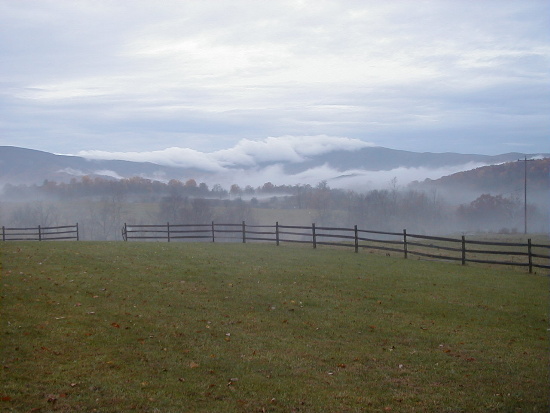
The Japanese artist Hokusai created a series of prints showing different views of Mt. Fuji, the great dormant volcano that is the most identifiable image in Japan. The artist said once "It struck me that it would be good to take one thing in life and regard it from many viewpoints, as a focus for my being, and perhaps as a penance for alternatives missed. " I once thought of titling this blog "365 Views of Hogback Mountain" for the same reason. In this, the fifth photo in answer to Gideon's question, Hogback sits cloud-covered with the hint of the mysterious found in all mountains.
Thursday, March 24, 2005
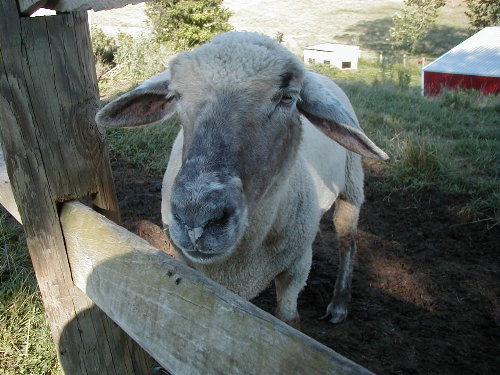
Our life is lived in the company of other creatures. This is Redsox, once a near lifeless lamb revived by my wife and raised on a bottle. She is now a ewe of mature years with many lambs of her own, but I still remember her as a lamb herself, nibbling on the remnants of the back yard roses. This picture was from an early summer afternoon a couple of years ago. I was out in the yard and she ambled over to say hello. She adapted to life with the other ewes quite well, but still thinks of us as her first flock. I found this shot while reviewing the blog archives and thought I would add it to the list as number four in answer to Gideon's question.
Wednesday, March 23, 2005
There are quite a few people out there who engage in an activity I refer to as "blogging in place." In the long delayed revision to the links on the right, I will list some of my favorites, many of whom are gracious enough to link this site. North Ontario blogger JoJo's Jelly has a list that includes this site for a blog from a place as far away from our farm as you can get without actually leaving the planet. Love the penguin pictures.
Tuesday, March 22, 2005

It is hard to read the Old Testament without running accross the concepts of blessing and abundance. We tend to think of abundance as a piling up of manufactured goods. As they say, "The one who dies with the most toys wins." Since moving out to the farm, I have broadened my definition. Clean skies, lush grass, trees in full leaf. Here are blessing and abundance illustrated in the third picture for Gideon's top five.
Monday, March 21, 2005
The latter part of the twentieth century was remarkable for the new flowering of Orthodox monasticism. As much as I appreciate the restoration of the great monasteries on Athos and the introduction of traditional monasticism to America and around the world, I have a special affection for those in the monastic life who follow a less conventional path, usually alone, without great fame or prestige. One such person was Mother Gavrilia, or to more properly anglicize the name, Mother Gabriel. I will not attempt to summarize her life, but instead will refer you to an excellent article at the Orthodox Peace Fellowship web site. There is also a good page at the web site of St. Gregory Palamas Monastery. For a selection of her sayings, go here. Since I still owe Gideon Strauss an answer to his questions, I will quote one that he may appreciate:
Someone said that a Christian is he who purifies love and sanctifies work.
Someone said that a Christian is he who purifies love and sanctifies work.
Sunday, March 20, 2005
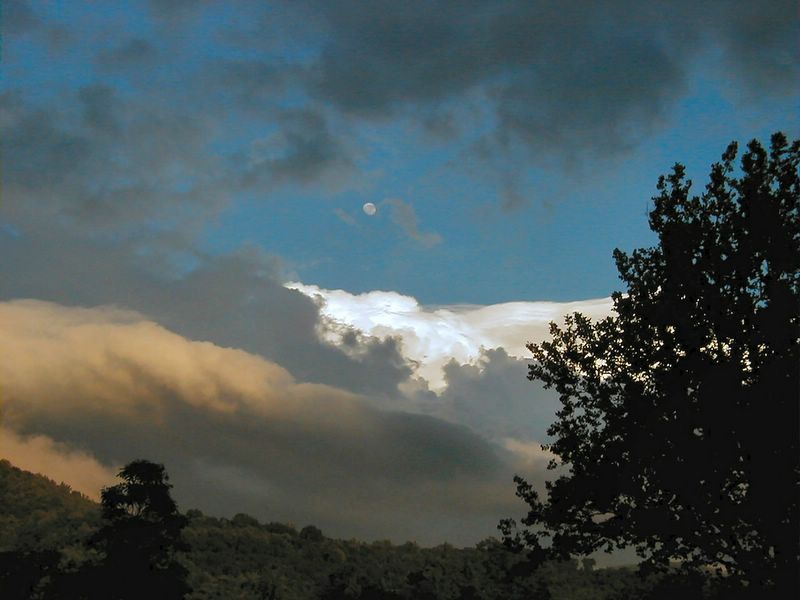
The sky over our farm is a source of endless fascination. Here is picture number two, taken at sunset with a rising moon. Rain clouds were clearing off and the quality of light was something beyond the ability of my little camera to capture. Someone linked to this photo when it was first posted, captioning it "God showing off."
Saturday, March 19, 2005

The answers to Gideon's questions will have to trickle in as the week goes on. With sick family members and a busy week at the office, blogging will get wedged into spare moments over the next few days. I have been browsing through the archives, looking at photos posted over the past three years to answer Question One. Here is my first candidate for the top five. Go here for the original post with the story behind the picture.
Friday, March 18, 2005
The on-line world is a peculiar mixture of the personal and the superficial. I now have long-standing acquaintances that I would consider good friends except for the simple fact that we have never actually met. I don't chat or engage in instant messaging, so my on-line interactions are limited to reading the works of others and exchanging a few quick notes. Rather like swapping post-cards with the author of an article you liked. Gideon Strauss recently invited his readers to answer five questions in an interview format, a way of finding out a little more about the man or woman hiding behind the blog. Self-reflection being one way of observing Lent, I sent in my request to participate, and Gideon forwarded the very good questions you see below. I will be reflecting on them over the weekend and will post answers as I get the chance. In the meantime, if any regular readers have a favorite photograph from the archives, or if you have a favorite very short poem, leave a note in the comment section or drop me a line at john.bell@gmail.com .
1. What four or five farm photographs on your blog would first want to show to new friends?
2. What is your favourite very short poem?
3. How has several generations of being farmed by the same family made your land a good place?
4. What is the most significant influence of the liturgical year on the life of your family?
5. What are the deepest connections between your Orthodoxy, farming, and lawyerly practice?
1. What four or five farm photographs on your blog would first want to show to new friends?
2. What is your favourite very short poem?
3. How has several generations of being farmed by the same family made your land a good place?
4. What is the most significant influence of the liturgical year on the life of your family?
5. What are the deepest connections between your Orthodoxy, farming, and lawyerly practice?
Thursday, March 17, 2005

Subscribe to:
Posts (Atom)