Friday, March 25, 2005


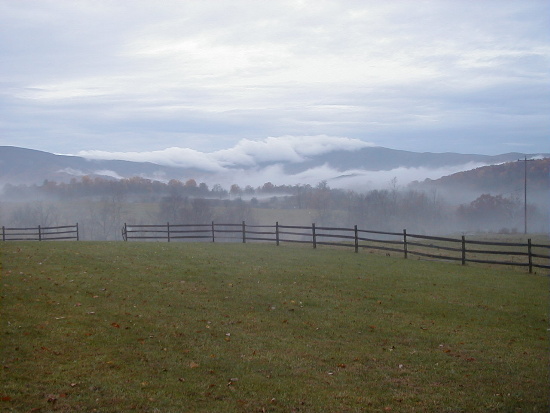
The Japanese artist Hokusai created a series of prints showing different views of Mt. Fuji, the great dormant volcano that is the most identifiable image in Japan. The artist said once "It struck me that it would be good to take one thing in life and regard it from many viewpoints, as a focus for my being, and perhaps as a penance for alternatives missed. " I once thought of titling this blog "365 Views of Hogback Mountain" for the same reason. In this, the fifth photo in answer to Gideon's question, Hogback sits cloud-covered with the hint of the mysterious found in all mountains.
Thursday, March 24, 2005
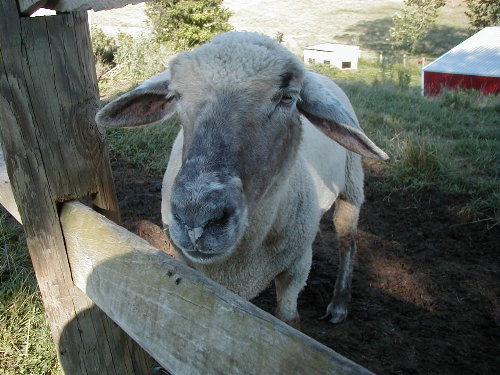
Our life is lived in the company of other creatures. This is Redsox, once a near lifeless lamb revived by my wife and raised on a bottle. She is now a ewe of mature years with many lambs of her own, but I still remember her as a lamb herself, nibbling on the remnants of the back yard roses. This picture was from an early summer afternoon a couple of years ago. I was out in the yard and she ambled over to say hello. She adapted to life with the other ewes quite well, but still thinks of us as her first flock. I found this shot while reviewing the blog archives and thought I would add it to the list as number four in answer to Gideon's question.
Wednesday, March 23, 2005
There are quite a few people out there who engage in an activity I refer to as "blogging in place." In the long delayed revision to the links on the right, I will list some of my favorites, many of whom are gracious enough to link this site. North Ontario blogger JoJo's Jelly has a list that includes this site for a blog from a place as far away from our farm as you can get without actually leaving the planet. Love the penguin pictures.
Tuesday, March 22, 2005

It is hard to read the Old Testament without running accross the concepts of blessing and abundance. We tend to think of abundance as a piling up of manufactured goods. As they say, "The one who dies with the most toys wins." Since moving out to the farm, I have broadened my definition. Clean skies, lush grass, trees in full leaf. Here are blessing and abundance illustrated in the third picture for Gideon's top five.
Monday, March 21, 2005
The latter part of the twentieth century was remarkable for the new flowering of Orthodox monasticism. As much as I appreciate the restoration of the great monasteries on Athos and the introduction of traditional monasticism to America and around the world, I have a special affection for those in the monastic life who follow a less conventional path, usually alone, without great fame or prestige. One such person was Mother Gavrilia, or to more properly anglicize the name, Mother Gabriel. I will not attempt to summarize her life, but instead will refer you to an excellent article at the Orthodox Peace Fellowship web site. There is also a good page at the web site of St. Gregory Palamas Monastery. For a selection of her sayings, go here. Since I still owe Gideon Strauss an answer to his questions, I will quote one that he may appreciate:
Someone said that a Christian is he who purifies love and sanctifies work.
Someone said that a Christian is he who purifies love and sanctifies work.
Sunday, March 20, 2005
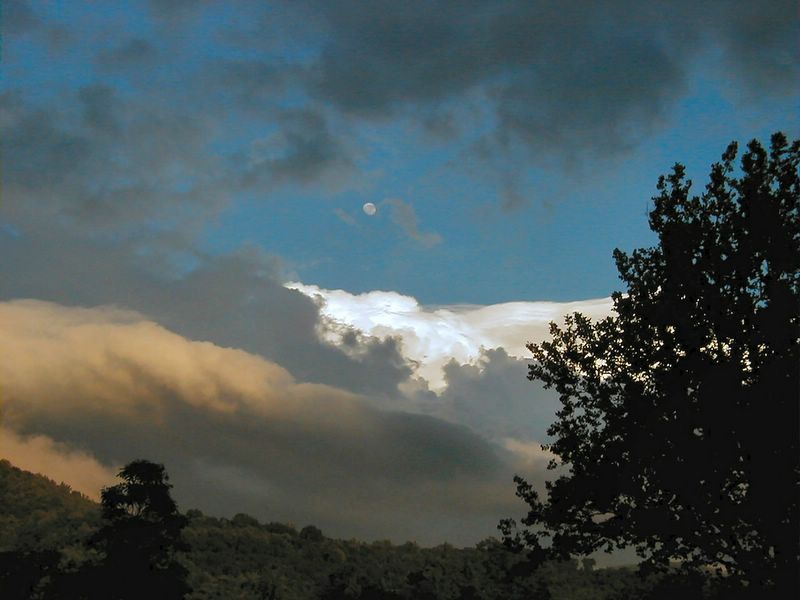
The sky over our farm is a source of endless fascination. Here is picture number two, taken at sunset with a rising moon. Rain clouds were clearing off and the quality of light was something beyond the ability of my little camera to capture. Someone linked to this photo when it was first posted, captioning it "God showing off."
Saturday, March 19, 2005

The answers to Gideon's questions will have to trickle in as the week goes on. With sick family members and a busy week at the office, blogging will get wedged into spare moments over the next few days. I have been browsing through the archives, looking at photos posted over the past three years to answer Question One. Here is my first candidate for the top five. Go here for the original post with the story behind the picture.
Friday, March 18, 2005
The on-line world is a peculiar mixture of the personal and the superficial. I now have long-standing acquaintances that I would consider good friends except for the simple fact that we have never actually met. I don't chat or engage in instant messaging, so my on-line interactions are limited to reading the works of others and exchanging a few quick notes. Rather like swapping post-cards with the author of an article you liked. Gideon Strauss recently invited his readers to answer five questions in an interview format, a way of finding out a little more about the man or woman hiding behind the blog. Self-reflection being one way of observing Lent, I sent in my request to participate, and Gideon forwarded the very good questions you see below. I will be reflecting on them over the weekend and will post answers as I get the chance. In the meantime, if any regular readers have a favorite photograph from the archives, or if you have a favorite very short poem, leave a note in the comment section or drop me a line at john.bell@gmail.com .
1. What four or five farm photographs on your blog would first want to show to new friends?
2. What is your favourite very short poem?
3. How has several generations of being farmed by the same family made your land a good place?
4. What is the most significant influence of the liturgical year on the life of your family?
5. What are the deepest connections between your Orthodoxy, farming, and lawyerly practice?
1. What four or five farm photographs on your blog would first want to show to new friends?
2. What is your favourite very short poem?
3. How has several generations of being farmed by the same family made your land a good place?
4. What is the most significant influence of the liturgical year on the life of your family?
5. What are the deepest connections between your Orthodoxy, farming, and lawyerly practice?
Thursday, March 17, 2005

Wednesday, March 16, 2005
For those of you who check daily, yes posts have been going up a day late. My home laptop and Blogger have both been having difficulties, hence the late postings. Blogger's troubles seem to have made the comments feature almost unusable. If you want to leave a note, send it on to me here. I will be happy to post any comments you would like to share with the rest of the readership. Just let me know if it is for public consumption or not.
Tuesday, March 15, 2005

Monday, March 14, 2005
The fellow attorney and Orthodox seminarian who blogs as Minor Clergy has a fine post on Forgiveness Sunday in his parish. Recommended reading on this first day of Lent.
Sunday, March 13, 2005
Today is Forgiveness Sunday in the Orthodox calendar, the last stop before Lent begins tomorrow. I drove into the city this morning to St. Mary's, my "home" parish where I was introduced to Orthodoxy, to join the congregation in asking each other for forgiveness, beginning our repentance with reconciliation. Here is an excerpt from Alexander Schmemann's Great Lent on the meaning of this Sunday:
Lent is the liberation of our enslavement to sin, from the prison of "this world." And the Gospel lesson of this last Sunday (Matt. 6:14-21) sets the conditions for that liberation. The first one is fasting -- the refusal to accept the desires and urges of our fallen nature as normal, the effort to free ourselves from the dictatorship of flesh and matter over the spirit. . . . The second condition is forgiveness-- "If you forgive men their trespasses, your Heavenly Father will also forgive you." The triumph of sin, the main sign of its rule over the world is division, opposition, separation, hatred. Therefore the first break through this fortress of sin is forgiveness: the return to unity, solidarity, love. To forgive is to put between me and my "enemy" the radiant forgiveness of God Himself. To forgive is to reject the hopeless "dead-ends" of human relations and to refer them to Christ. Forgiveness is truly a "breakthrough" of the Kingdom into this sinful and fallen world.
We begin our fast with an act of reconciliation, a return to unity with those around us. The fast itself teaches us another lesson as we struggle. It should be simple enough; eat this, not that. No real sacrifice, just a demand for a little effort and a modicum of attention to the daily routine. Soon enough, I know, I will start looking for excuses, exceptions, exemptions. Worse still, I will simply forget and have that cheeseburger half eaten before I give a second thought to what I am doing, or why. As the Apostle Paul said in his letter to the Romans, "I do not understand my own actions. For I do not do what I want, but I do the very thing I hate." The fast makes me realize that, not only am I divided from those around me, I am divided within myself, walking about in a kind of daydream constructed of appetite and ingrained habit. Again in the words of the Apostle, "Wretched man that I am! Who will deliver me from this body of death?"
So, is Lent simply an annual run into the brick wall of your own failures and finitude, a reminder that one is, in fact, a sinner? No, or, if there is some truth there, it is only a half truth. The final word of Lent is spoken not in Lent itself, but just after midnight as Holy Saturday turns into Easter Sunday. Who will deliver me from this body of death? The answer comes as we sing triumphantly, "Christ is risen from the dead, trampling down death by death, and upon those in the tombs bestowing life." Despite all appearances, there are no "dead-ends" in ourselves, our lives, our relationships. At any moment the Kingdom is poised to break in and our Lenten disciplines teach us to wait with hope, and with great expectations.
Lent is the liberation of our enslavement to sin, from the prison of "this world." And the Gospel lesson of this last Sunday (Matt. 6:14-21) sets the conditions for that liberation. The first one is fasting -- the refusal to accept the desires and urges of our fallen nature as normal, the effort to free ourselves from the dictatorship of flesh and matter over the spirit. . . . The second condition is forgiveness-- "If you forgive men their trespasses, your Heavenly Father will also forgive you." The triumph of sin, the main sign of its rule over the world is division, opposition, separation, hatred. Therefore the first break through this fortress of sin is forgiveness: the return to unity, solidarity, love. To forgive is to put between me and my "enemy" the radiant forgiveness of God Himself. To forgive is to reject the hopeless "dead-ends" of human relations and to refer them to Christ. Forgiveness is truly a "breakthrough" of the Kingdom into this sinful and fallen world.
We begin our fast with an act of reconciliation, a return to unity with those around us. The fast itself teaches us another lesson as we struggle. It should be simple enough; eat this, not that. No real sacrifice, just a demand for a little effort and a modicum of attention to the daily routine. Soon enough, I know, I will start looking for excuses, exceptions, exemptions. Worse still, I will simply forget and have that cheeseburger half eaten before I give a second thought to what I am doing, or why. As the Apostle Paul said in his letter to the Romans, "I do not understand my own actions. For I do not do what I want, but I do the very thing I hate." The fast makes me realize that, not only am I divided from those around me, I am divided within myself, walking about in a kind of daydream constructed of appetite and ingrained habit. Again in the words of the Apostle, "Wretched man that I am! Who will deliver me from this body of death?"
So, is Lent simply an annual run into the brick wall of your own failures and finitude, a reminder that one is, in fact, a sinner? No, or, if there is some truth there, it is only a half truth. The final word of Lent is spoken not in Lent itself, but just after midnight as Holy Saturday turns into Easter Sunday. Who will deliver me from this body of death? The answer comes as we sing triumphantly, "Christ is risen from the dead, trampling down death by death, and upon those in the tombs bestowing life." Despite all appearances, there are no "dead-ends" in ourselves, our lives, our relationships. At any moment the Kingdom is poised to break in and our Lenten disciplines teach us to wait with hope, and with great expectations.
Saturday, March 12, 2005
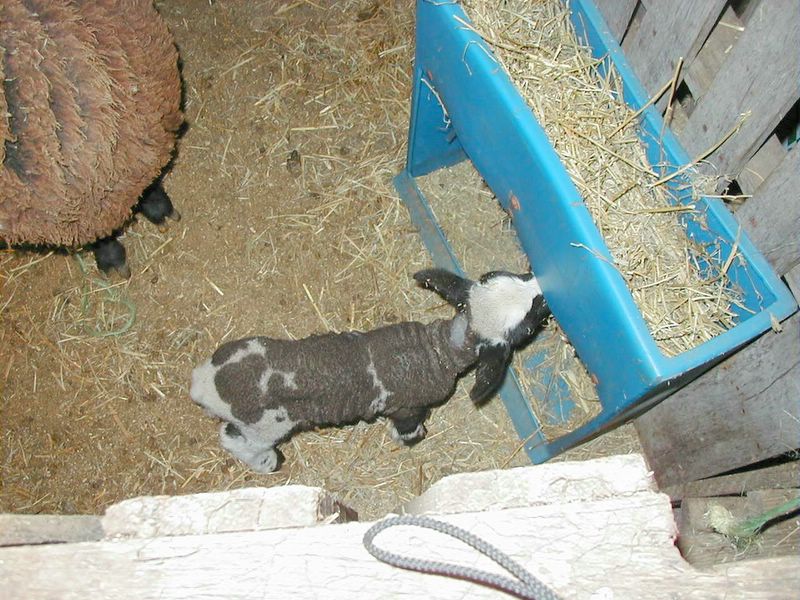
Today we got the whole family down to the barn for one of my least favorite parts of the shepherd's job; tail docking and castrations. If you go down the page to some lamb pictures, you will notice they are born equipped each with a nice long tail, quite unlike the small appendages on their mothers. So, why take them off? Unfortunately those cute little tails become muddy manure clotted messes as sheep get older, a path for disease and fly infestations. So, off they go. I will not describe the process for the faint of heart except to say that the the little critters are all fine and properly docked. About the castrations of the ram lambs not destined for breeding, the less said the better. Susan does it quickly and efficiently with utter disdain for the squeamish males surrounding her, wincing in shared horror and sympathy.
Here is a the classic nursery rhyme, on the subject of lambs and their tails and the travails of a young shepherdess who needs to get with the program:
Little Bo Peep has lost her sheep
And doesn't know where to find them.
Leave them alone, and they'll come home,
Bringing their tails behind them.
Little Bo peep fell fast asleep
And dreamt she heard them bleating;
But when she awoke, she found it a joke,
For they were still a-fleeting.
Then up she took her little crook,
Determined her to find them;
She found them indeed,
but it made her heart bleed,
For they'd left their tales behind them.
It happened one day, as Bo peep did stray
Into a meadow hard by,
There she espied their tales side by side,
All hung on a tree to dry.
She heaved a sigh and wiped her eye,
And over the hillocks went rambling,
And tried what she could, as a shepherdess should,
To tack each again to its lambkin.
Here is a the classic nursery rhyme, on the subject of lambs and their tails and the travails of a young shepherdess who needs to get with the program:
Little Bo Peep has lost her sheep
And doesn't know where to find them.
Leave them alone, and they'll come home,
Bringing their tails behind them.
Little Bo peep fell fast asleep
And dreamt she heard them bleating;
But when she awoke, she found it a joke,
For they were still a-fleeting.
Then up she took her little crook,
Determined her to find them;
She found them indeed,
but it made her heart bleed,
For they'd left their tales behind them.
It happened one day, as Bo peep did stray
Into a meadow hard by,
There she espied their tales side by side,
All hung on a tree to dry.
She heaved a sigh and wiped her eye,
And over the hillocks went rambling,
And tried what she could, as a shepherdess should,
To tack each again to its lambkin.
Friday, March 11, 2005
Thursday, March 10, 2005
Our weather has taken a turn back into Winter lately; snow showers with unseasonable cold driven even further down the scale by brisk winds. Bishop Seraphim, who lives several hours north of our supposedly Southern latitude has coined a new phrase, "Indian Winter," to capture our current climactic variation. On the road just outside of town, frozen daffodils wilt in the median, relics of the warm breezes that came through just a short time ago.
Midwinter spring is its own season
Sempiternal though sodden towards sundown,
Suspended in time, between pole and tropic.
When the short day is brightest, with frost and fire,
The brief sun flames the ice, on pond and ditches,
In windless cold that is the heart's heat,
Reflecting in a watery mirror
A glare that is blindness in the early afternoon.
And glow more intense than blaze of branch, or brazier,
Stirs the dumb spirit: no wind, but pentecostal fire
In the dark time of the year. Between melting and freezing
The soul's sap quivers. There is no earth smell
Or smell of living thing. This is the spring time
But not in time's covenant. Now the hedgerow
Is blanched for an hour with transitory blossom
Of snow, a bloom more sudden
Than that of summer, neither budding nor fading,
Not in the scheme of generation.
Where is the summer, the unimaginable
Zero summer?
From "Little Gidding" Four Quartets by T. S. Eliot
Midwinter spring is its own season
Sempiternal though sodden towards sundown,
Suspended in time, between pole and tropic.
When the short day is brightest, with frost and fire,
The brief sun flames the ice, on pond and ditches,
In windless cold that is the heart's heat,
Reflecting in a watery mirror
A glare that is blindness in the early afternoon.
And glow more intense than blaze of branch, or brazier,
Stirs the dumb spirit: no wind, but pentecostal fire
In the dark time of the year. Between melting and freezing
The soul's sap quivers. There is no earth smell
Or smell of living thing. This is the spring time
But not in time's covenant. Now the hedgerow
Is blanched for an hour with transitory blossom
Of snow, a bloom more sudden
Than that of summer, neither budding nor fading,
Not in the scheme of generation.
Where is the summer, the unimaginable
Zero summer?
From "Little Gidding" Four Quartets by T. S. Eliot
Wednesday, March 09, 2005
The "eclectic but orthodox" folks at Eighth Day Books have put together a series of excellent suggestions for Lenten reading. As useful as Amazon may be, we shouldn't forget about those wonderful independents like Eighth Day who operate as much for love as for profit. Owner Warren Farha reflects on his vocation here.
Tuesday, March 08, 2005
Subscribe to:
Posts (Atom)